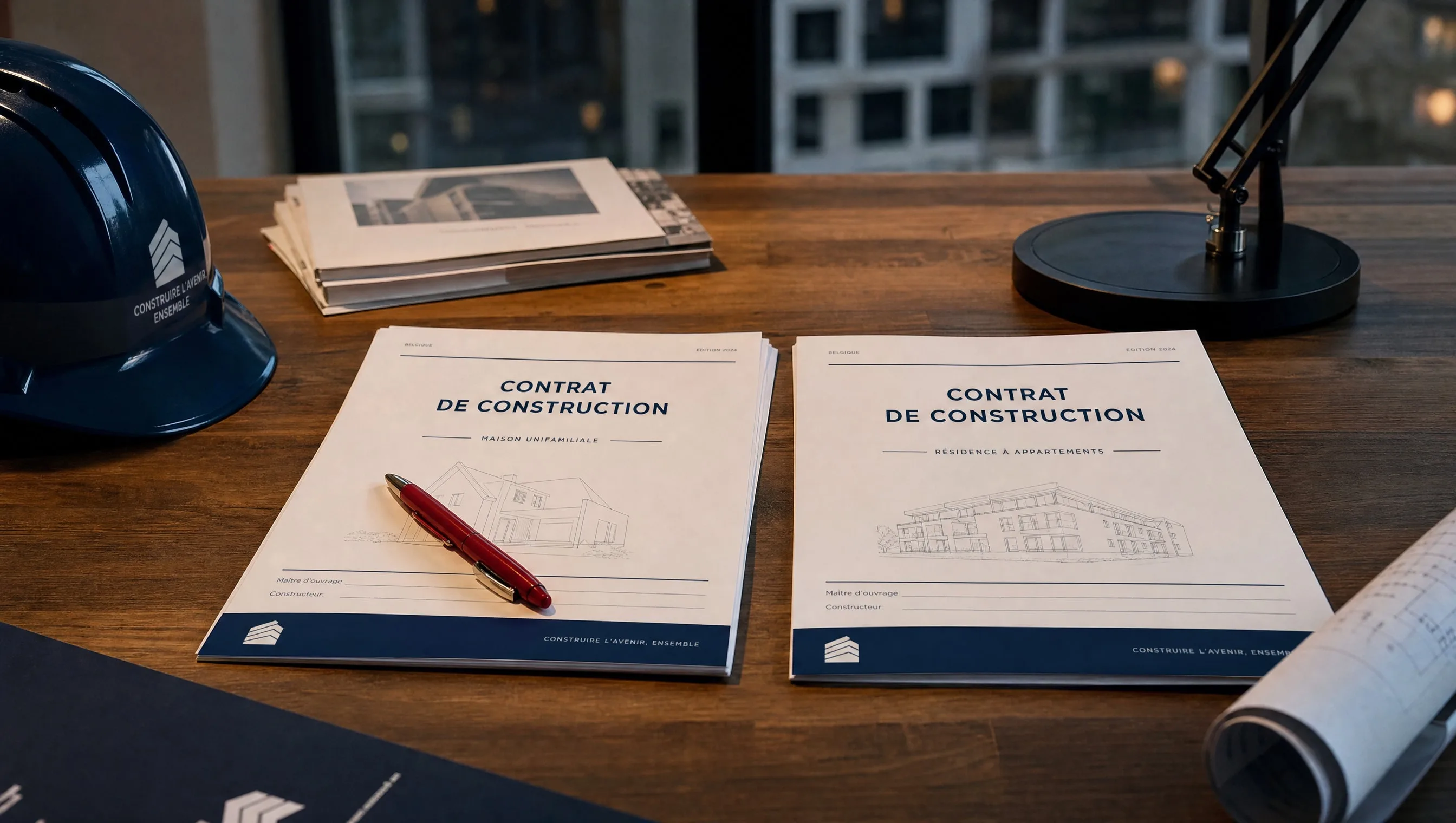
Comparing construction contract clauses on price alone is the biggest mistake I see in my practice. On 47 contracts reviewed in 2026, the real risk gap between an offer at €285,000 and one at €270,000 often reached €20,000 in favour of the more expensive contract — the opposite of what a naive comparison would suggest. The reason is simple: sales reps play on the headline price and offset it by hiding risk in 8 technical clauses that few owners read in detail. Here is the reading grid I systematically apply.
The 4 financial clauses to check
1. The indexation clause
Check the reference index used (ABEX, type II, dwelling index, general construction index). Indexes vary from 1.5 to 4% per year, and a contract without an indexation cap can drift the budget by 8% in six months during inflationary periods. Favour the standard clause: “ABEX type II index capped at 4% cumulative over the duration of the works.”
2. Down payments and their triggers
Percentage per instalment and triggering stage: at signing (max 5% under the Breyne Law), closed shell, weather-tight, finishing. Refuse contracts demanding more than 5% at signing or triggering instalments on vague stages such as “state of progress noted by the contractor.”
3. Late penalties
€50 to €150 a day is the standard Belgian market range in 2026. Check the cap (typically 10% of the total price) and especially the starting point: it must be the contractual deadline written in the contract, not a date “potentially shifted by oral agreement.”
4. The retention guarantee
5% minimum until final reception is the norm. But watch the release mechanics: retention released at the lifting of the last reservations, not at the signing of the provisional reception minutes. This nuance protects your interest for 6 to 12 additional months.
The 2 essential technical clauses
5. Precise description of materials
The real differentiator hides here. Compare:
- “White PVC windows Uw≤1.3” (vague, modifiable without agreement)
- “Reynaers Eurodes ASS70 PVC white windows Uw=1.1, 4/16/4/16/4 argon glazing” (precise, enforceable)
A vague description lets the contractor substitute lower-performing materials mid-project with no possible recourse. Of the 47 audited contracts, 31 contained at least 4 “equivalent” references that were swapped to the contractor’s benefit.
6. Items excluded from the lump sum
Exhaustive and quantified list of items not included. Without this list, you discover “unforeseen” extras at every stage: specific earthworks, connections beyond 20 m, municipal premiums, urban planning fees, surroundings, frost protection. The total “outside the lump sum” can represent 8 to 18% of the announced price.
The 2 critical legal clauses
7. Competent court and mediation
Competent court: prefer the court of the client’s domicile over the contractor’s registered office (your travel and your costs are lower). Check the mandatory prior mediation clause before any judicial action — useful for small disputes, binding for big ones.
8. Final reception and reservation-lifting deadlines
Final reception deadline: 6 months to 1 year after provisional is the norm. A 24-month contract abnormally extends the owner’s liability. The reservation-lifting procedure must be timed: 30 days for minor defects, 90 days for major defects.
Recurring pitfalls
Of the 47 contracts audited in 2026, here are the most recurring traps:
- Indexation clauses without a cap (16 contracts out of 47)
- Down payments above 5% at signing (12 contracts, contrary to the Breyne Law)
- Unilateral penalties: delay paid by the contractor, but no penalty if you delay your approvals
- Completion guarantee missing or with a dubious surety body
- Material description too vague (“equivalent” references)
- Competent court far away (contractor’s registered office)
For the full legal framework of the Breyne Law, see ejustice.just.fgov.be — Act of 9 July 1971.
Pitfalls to avoid
- Never sign a turnkey contract without having it re-read by a third party
- Do not trust verbal promises: only the contract text counts
- Beware of “pre-printed” non-modifiable contracts
- Keep all annexes (specifications, plans, technical sheets) with the contract
- Check the registration for the completion guarantee (Breyne Law obligation)
What next?
The real price of a contract is not its amount: it is what it will cost you in the worst-case scenario. And the worst-case scenario is always more likely than people think. If you are comparing two or three offers, my practice offers a Breyne Law advisory service that includes comparative reading and the drafting of a synthesis report, or request a free quote specifying the number of contracts to compare.