Construction defect · Defects & construction flaws
Damp in a new home: sources and treatments in Belgium
Severity ⚠ High
Reporting deadline 90 days
Warranty Ten-year
Responsibility Contractor
How to detect abnormal damp?
A new home must show no traces of damp, stains, mould, saltpetre or peeling paint. The three main sources: infiltration (rainwater passing through facade, roof or joints), condensation (airborne moisture settling on cold surfaces), rising damp (groundwater rising through foundations without a damp-proof course). Use a hygrometer to measure relative ambient humidity (ideally 40-60%) and material moisture with a moisture meter. Above 4% on concrete or 18% on wood, the defect is reportable. Inspect after driving rain, at the base of walls, at floor/wall junctions, around windows and under the roof.
Before — compliant
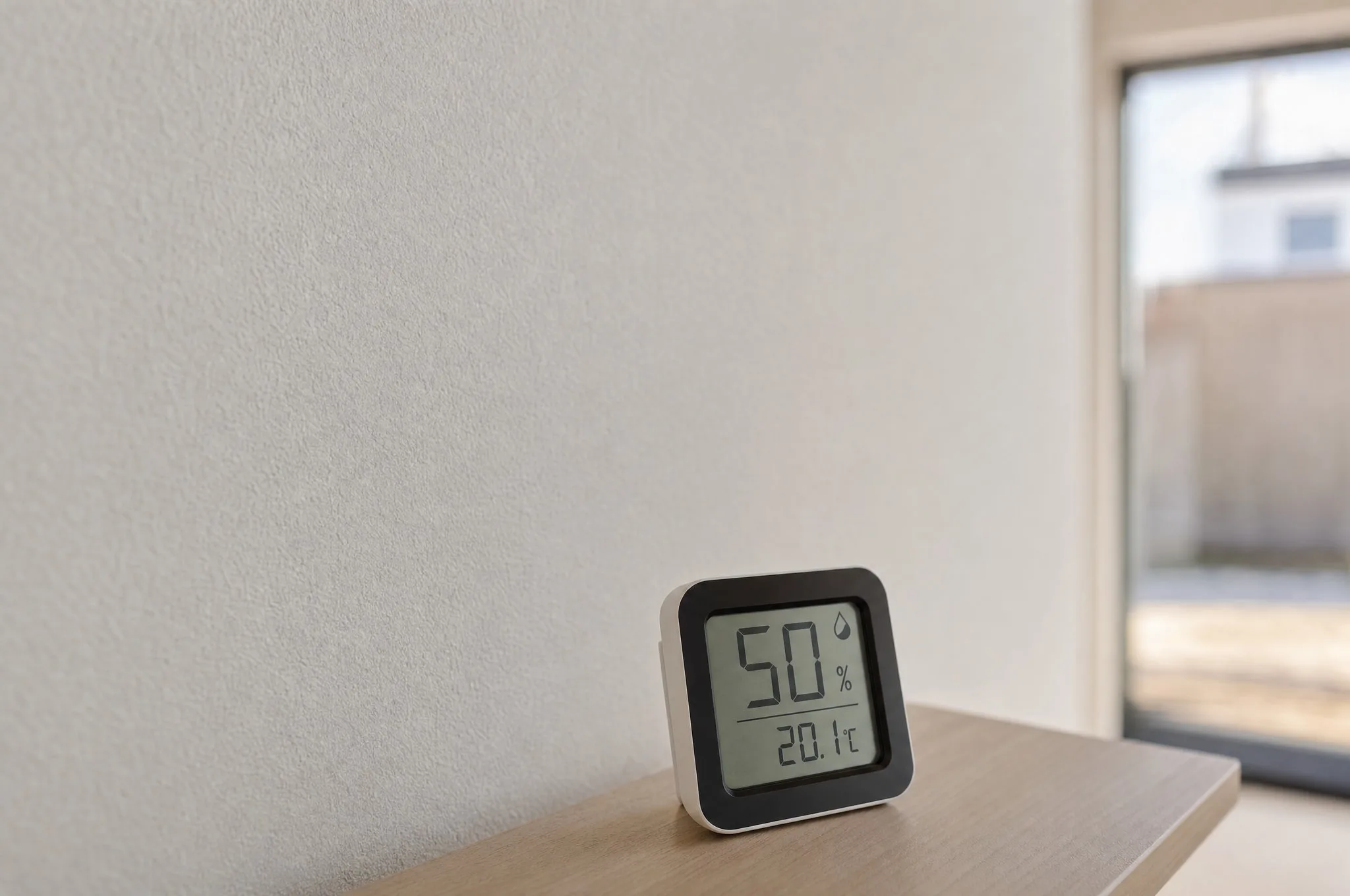
No stains · material < 4% · ventilation OK
⚠ After — defective
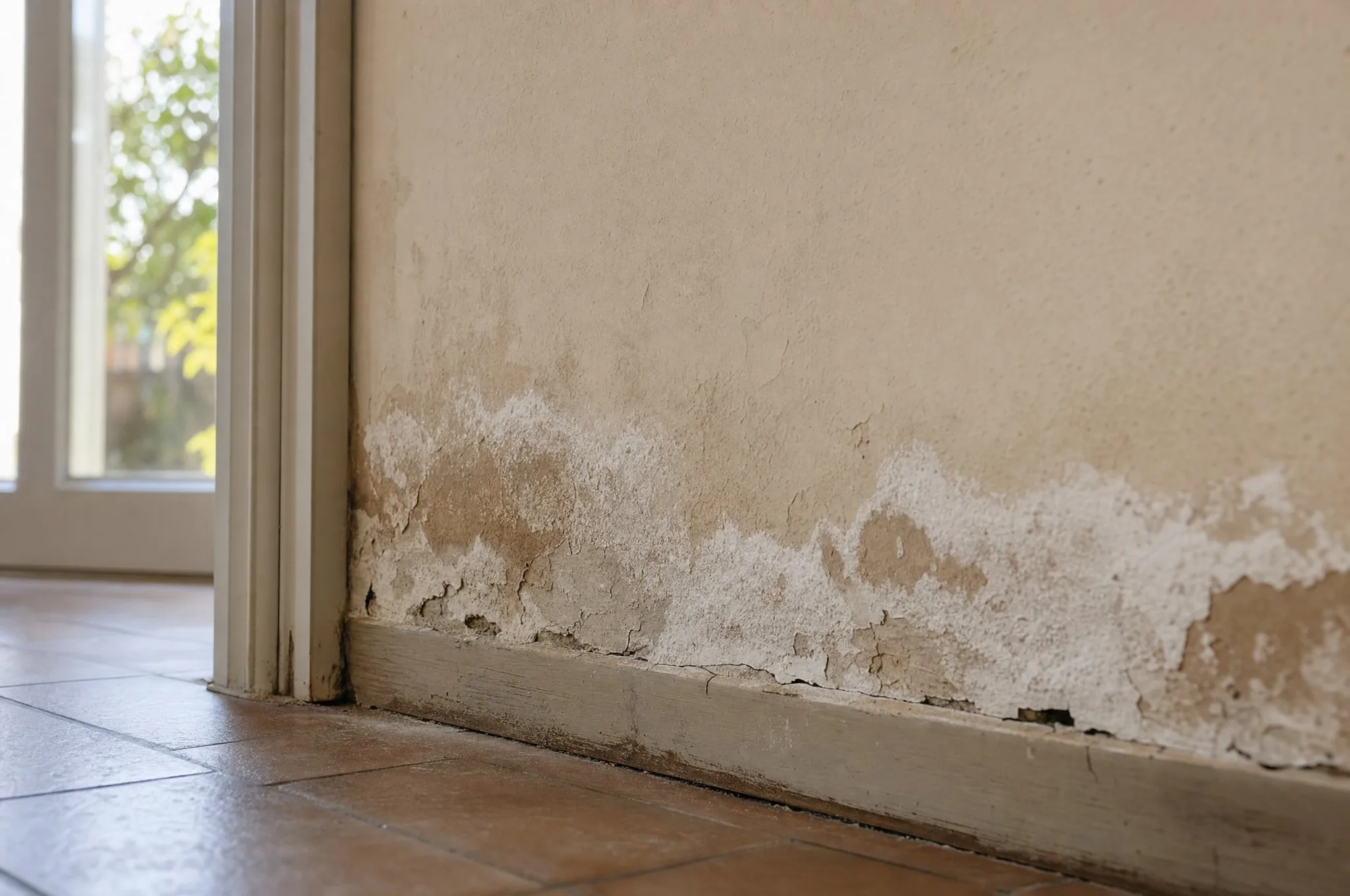
Active rising damp · failed DPC · to be reported
Reporting procedure in 4 steps
Damp in a new-build generally falls under the ten-year liability because it renders the property unfit for normal use. A rigorous procedure is essential.
-
1
Identify the source
Ambient hygrometer, material moisture meter. Photos in chronological order (after rain, in winter, in summer). Precise location, height of stains, presence of saltpetre.
-
2
Document over time
Dated photos each month for 3-6 months. Logbook: rainfall, hygrometry, stain evolution. Essential to prove the evolving nature.
-
3
Formal notice
Registered letter to the contractor within 90 days of discovery. Attach photo file, hygrometric measurements, conditions of appearance.
-
4
Damp expert assessment
Independent damp-specialist building expert. Soundings, thermal camera, samples. Admissible report · from €480 VAT incl. Cost recoverable.
Who pays for the treatment? Responsibility table
The origin of the damp determines responsibility. In new-builds, the contractor is almost always liable.
Roof infiltration
✓ ten-year liability
—
ARI + structural
Rising damp (missing DPC)
✓ ten-year liability
—
ARI
Condensation (no MVHR)
✓ two-year warranty
—
—
Thermal bridge wall/slab
✓ ten-year liability
—
—
Overuse (8 occupants)
—
✓ ventilation
—
Get an inspection
Independent damp inspection of your home
Thermal camera · soundings · from €480 VAT incl.
FAQ
Common questions about damp
My new home smells damp. Normal in the first year?+
A slight smell of concrete or plaster is normal in the first months (drying). But a true damp smell, especially localised, is never normal and indicates a defect to investigate quickly.
Saltpetre is appearing at the base of a wall. What should I do?+
Saltpetre (cotton-like white crystals) indicates rising damp (water moving up from the ground). In a new-build, the damp-proof course between foundations and masonry was poorly installed or forgotten. Major ten-year defect. Report immediately.
My windows are covered in condensation every morning. Is this a problem?+
Moderate condensation is tolerable in winter if MVHR is active. Beyond that, a mechanical ventilation defect (MVHR missing, misadjusted, blocked ducts). Have the MVHR checked under the two-year warranty.
The contractor says I do not ventilate enough. Is that true?+
A new home built to Belgian EPC standards is very airtight and requires an EFFICIENT MVHR. If the MVHR meets specifications and you ventilate normally, the defect is constructive. Have the MVHR flow rate measured with a flow meter.
How much does rising-damp treatment cost?+
Between €3,500 and €12,000 VAT incl. depending on wall length and method (resin injection, electro-osmosis, peripheral drain). At the contractor's expense if a construction defect is established.