What is a construction flaw or defect?
A construction flaw designates an execution defect: work carried out in violation of industry rules, specifications or applicable standards. Misaligned tiling, paint peeling after three months, a partition sounding hollow, poorly applied roof weatherproofing — concrete examples. The flaw is attributable to the contractor or worker who performed the work.
A construction defect is broader. It is any defect affecting the building, whether due to poor execution (flaw), faulty design (architect’s fault), defective material (supplier’s responsibility), or a ground defect (unforeseeable defect). Belgian law primarily distinguishes visible defects (apparent at reception) from hidden defects (revealed through use).
This distinction is fundamental because it conditions the remedies available and the deadlines to act. A crack visible on the reception day, not reported in the minutes, is in principle covered by the reception — you can no longer claim it. An infiltration appearing three years later is a hidden defect: the ten-year liability fully applies.
The four warranties protecting the Belgian buyer
The Belgian system layers several warranty regimes. Distinguishing them well allows activating the right remedy according to the nature of the defect.
1. The perfect-completion warranty (1 year) — Article 1792 old Civil Code and Article 9 Breyne Law. During the year following provisional reception, the contractor must lift all reservations raised in the minutes and repair all defects appearing through use, major or minor.
2. The two-year warranty — Covers equipment items detachable from the shell: water heater, ventilation, taps, integrated appliances, boiler. The period runs from reception. Beyond 2 years, these items fall under common sales law.
3. The ten-year liability — Articles 1792 and 2270 old Civil Code. This is the major warranty. It covers defects affecting the solidity of the building or rendering it unfit for its purpose: structural defects, major leaks, weatherproofing failures, foundation issues, ground defects. It weighs jointly on the contractor and the architect — and is mandatorily covered by an insurance (Peeters-Borsus Act of 31 May 2017, Belgian Official Gazette).
4. The hidden-defects warranty — Common sales law, Cassation case law. It applies to defects not detectable at reception and rendering the building unfit for expected use. Period: 10 years for construction, from discovery of the defect.
To this is added, for Breyne Law purchases, the 5% security deposit (Article 12) which remains mobilisable during the perfect-completion warranty year to have repairs carried out by a third party.
Our comprehensive guide Construction warranties details each of these regimes.
Typology of the most frequent construction flaws in Belgium
Field experience shows that flaws concentrate on a few recurring trades. Knowing them allows focusing inspection at reception.
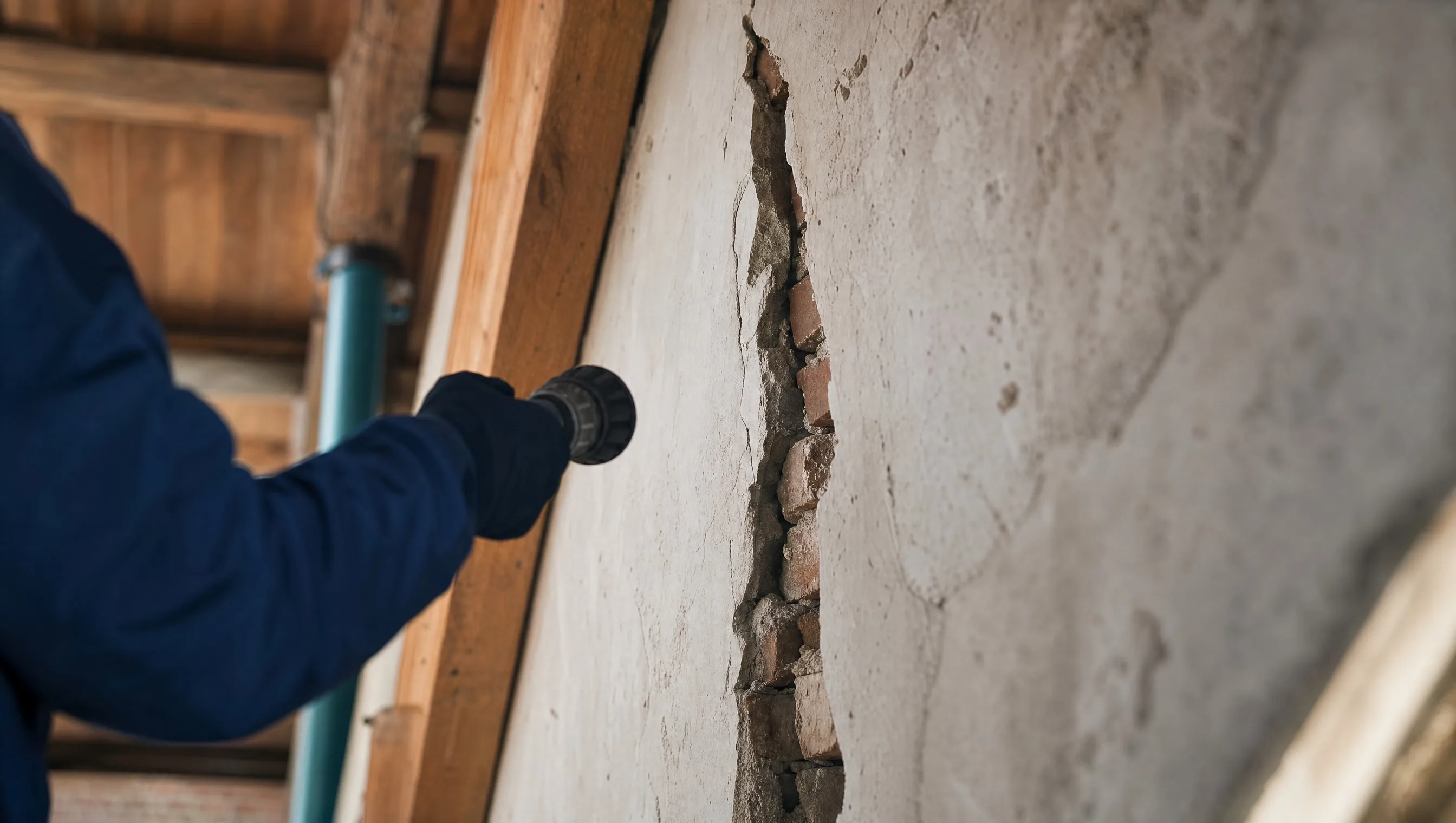
Shell and structure — Cracks (shrinkage, structural, through), slab subsidence, tie-beam defects, flaws in beams or lintels. The Buildwise (former CSTC) technical information notes serve as field reference for characterising this type of disorder. Regime: ten-year liability in nearly all cases. See cluster Cracks and Structural defects.
Roof and weatherproofing — Underlay laying defects, poorly fixed tiles, non-watertight ridge, undersized gutters, leaking flat roofs. Regime: ten-year as soon as there is infiltration affecting normal use. See cluster Infiltrations.
Windows and external joinery — Insufficient air- and water-tightness, defective seals, deforming windows, poorly sealed frames. Regime: ten-year if weatherproofing failure, two-year otherwise.
Electricity — Panel not AREI-compliant, earthing faults, miswired sockets, undersized circuits. The OCT certificate (technical inspection body) signed at reception does not exonerate the contractor. Regime: variable (ten-year if serious non-compliance, two-year otherwise).
Plumbing and sanitary — Hidden leaks, undersized drains, defective connections, ventilation defect. Often a visible reservation + two-year warranty.
Insulation and EPC — Failed airtightness, thermal bridges, missing or sagging insulation. The EPC certificate does not cover actual compliance — if the property underperforms, non-compliance with specifications and declared EPC can be invoked.
Finishes — Poorly laid tiles, joints, paint, skirting, poorly adjusted doors. Almost always visible reservations + two-year warranty for equipment.
Distinguishing visible defect from hidden defect
The visible defect is observable on the reception day or detectable by normal inspection. A 5mm crack in the living-room wall, a sticking door, a leaking tap — all visible. The legal rule is strict: visible defect not reported in minutes = defect covered by reception. You lose your remedies on that specific point.
The hidden defect is one that does not appear during normal inspection by a diligent buyer. An infiltration manifesting only at the first driving rain in November, a shrinkage crack appearing only after complete drying, a structural defect revealed two years later — all hidden defects. They remain covered by the ten-year liability (if affecting solidity or purpose), the two-year warranty (equipment) or the Civil Code hidden-defects warranty.
The boundary is sometimes subtle. A minor defect visible in the minutes (1mm micro-crack) which later evolves into a structural crack remains attributable to the contractor under ten-year liability — case law considers it unreasonable to anticipate its evolution. Conversely, not reporting a hollow-sounding partition on reception day later bars claiming its replacement.
To dig deeper: Visible construction defects and Hidden construction defects.
“The ten-year liability covers defects compromising the solidity of the building or one of its essential elements, as well as those rendering it unfit for its purpose.”
Article 1792 old Civil Code
The recourse procedure: from dialogue to legal action
Faced with an observed flaw, the effective procedure follows four steps in a near-mandatory order. Skipping a step weakens the final file.
Step 1 — Written report and dialogue. First action: send a letter (simple or registered) to the contractor describing precisely the defect, its location, its observation date. Request an on-site appointment and a repair schedule. Keep all exchanges.
Step 2 — Registered formal notice. If the contractor stays silent or offers insufficient solution, send a formal notice by registered letter with acknowledgement of receipt. The letter must:
- Recall the contract and the contractor’s obligations
- Precisely describe the defects (with photos in annex)
- Formally require repair within a reasonable period (15-30 days)
- Announce the remedies envisaged in case of default
The formal notice starts moratory interest and constitutes essential proof. See our contractor formal notice template.
Step 3 — Expert appraisal. If the dispute persists, have an expert report drawn up. Two options:
- Amicable expertise: an expert architect drafts an objective report (€300-1,500). Useful document for negotiation or to ground an action.
- Judicial expertise: you petition the summary judge who appoints a sworn expert. The procedure is more formal (contradictory, written conclusions, costs around €2,000-4,000 advanced by the claimant). The judicial report has special probative force.
Step 4 — Legal action. Before the business court (competent for B2B and B2C construction disputes) or the magistrates’ court (for small amounts). Proceedings last 12 to 24 months on average, with a financial burden (lawyer, expert, court fees) to weigh against the stakes.
Judicial expertise: the cornerstone of litigation
When stakes exceed a few thousand euros, judicial expertise becomes essential. It is the procedure by which the judge appoints an independent expert to observe the defects, establish their origin and cost the repairs.
How to obtain it. You petition the summary judge of the business court via summary-expertise summons. Proceedings last 2 to 4 months. Costs: bailiff summons (€250-450), court fees (€165), expertise provision (€1,500-4,000 depending on complexity).
How the expertise proceeds. The expert convenes the parties (you, the contractor, their lawyer, their insurer) on site. They prepare a contradictory report: pre-report, party observations, final report. The whole takes 6 to 18 months.
Probative force. The judicial expert report is rarely challenged by the trial judge. It costs reinstatement works, identifies the liable parties, grounds the condemnations.
See our page Judicial construction expertise and Business court.
The mediation alternative
Before or during legal action, mediation can avoid years of proceedings. It is sometimes imposed by contract (prior mediation clause) or recommended by the judge.
Principle. An accredited mediator (architect or trained lawyer) listens to both parties separately then together, proposes resolution paths. Proceedings are confidential and last 1 to 3 months. Cost: €800 to €2,500 to share.
Success rate. According to Federal Mediation Centre figures, about 60% of construction mediations result in agreement, against at least 18 months for a judicial decision. For small disputes (< €20,000), this is almost always the most profitable route.
Mandatory ten-year insurance: a safety net
Since the Peeters-Borsus Act of 31 May 2017, all contractors and architects working on new-build dwellings in Belgium must subscribe to a ten-year liability insurance. This obligation protects the buyer even in case of company bankruptcy.
Verification. Before reception, demand the contractor’s ten-year insurance certificate. Check: insurer details, policy number, coverage period. In doubt, contact the insurer directly to confirm.
Activation. If a ten-year defect appears after the contractor’s bankruptcy, you address your claim directly to the insurer, with expert report. The insurer may appoint their own expert before compensation.
Conclusion
Construction flaws and defects are not inevitable — but their handling requires method and rigour. Four principles guide effective action: (1) methodically document every defect (dated photos, kept e-mails); (2) respect the chronology of remedies (report → formal notice → expertise → court); (3) engage a technical expert before any contentious action; (4) monitor the warranty deadlines that time-bar remedies.