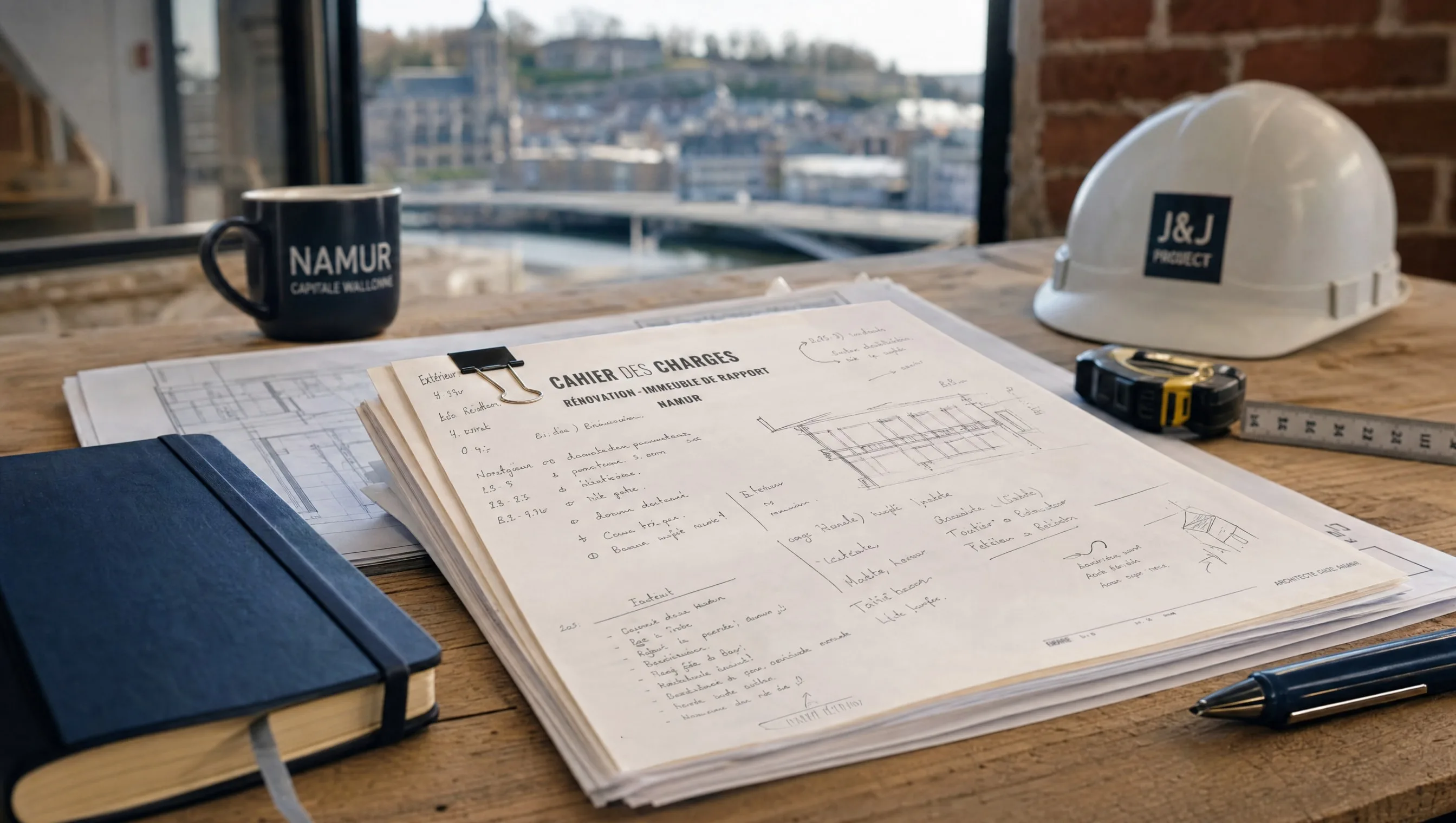
The construction specifications are the most structuring contractual piece, and they are also the document private clients read least. In 2026, of the 47 dispute cases I expert-reviewed this year in my practice, 39 rested on vague wording of the special specifications. The rule is simple: vague specifications are specifications that will later be settled by six months of registered letters and, in 30 % of cases, by court action. Here are the 9 sections I systematically verify before validating a client’s signature.
Section 1: materials and techniques (the heart of the system)
Precise brand and reference for each material (never “equivalent”): bricks, tiles, windows, boiler, parquet, tapware, sanitary. The word “or equivalent” is the highway of disputes: it allows the contractor to substitute a premium brand with a generic brand without possible recourse. Insulation classes quantified in lambda (W/m·K) and thermal resistance R, never just thickness. Applicable DTU standards cited by number and version. And above all: product origin, because a window labelled “PVC German quality” can come from a Romanian factory.
Out of 47 audited contracts, I saw 31 with at least 4 “equivalent” references diverted during the site. Average cost for owners: 3,200 € real quality reduction.
Section 2: deadlines and penalties
Start date and end date of the site with quantified late penalties (50 to 150 €/day depending on the project). Detailed phasing: weather-tight shell, plastering, services, finishes. Conditions for site suspension (bad weather, holidays, supply disruptions). Without an explicit penalty clause, the contractor has no financial incentive to respect the schedule — I have seen sites delayed by 11 months without any penalty due, for lack of a precise clause.
Section 3: finance and warranties
Payment schedule aligned with actual progress, not a fixed calendar. Retention guarantee of 5 % minimum until final reception (Breyne Law obligation). Indexation clause limited to an official index (ABEX, type II) with annual cap. And the exhaustive list of excluded works — that’s often where surprises of 4,000 to 18,000 € during the site are nested.
Section 4: insurance and liability
Five insurances must be documented in the specifications:
- Mandatory ten-year liability insurance of the contractor (law of 31 May 2017)
- Professional liability covering execution damages
- Site liability for claims during execution
- Completion guarantee under the Breyne Law (named surety body)
- All-risks site (ABR) insurance if complex shell
Systematically check the validity of the policies, not just their existence. An expired insurance has no effect.
Section 5: modifications and amendments
Mode of managing modifications during the site: increased lump sum or displayed unit prices. Without this section, every addition becomes a negotiation where you are in a weak position. Acceptance period for an amendment (usually 7 days) and written validation procedure — no oral amendments, ever.
Section 6: plans and annexes
Exhaustive list of annexes: execution drawings, layout plans, technical plans (electricity, plumbing, ventilation), measurements, 3D perspectives. Each annex must be initialled and dated. An un-initialled annex can be contested as not enforceable.
Section 7: reception and warranties
Procedure of provisional reception: conditions, completion deadline, mandatory attendance. Lifting of reservations: timed deadlines (30 days minor, 90 days heavy). Final reception: at 6 months or 1 year post-provisional. These clauses set the legal balance of power for the next 10 years.
Section 8: disputes and jurisdiction
Mandatory prior mediation before legal action. Competent court: prefer the one at the client’s domicile. Arbitration clause optional (best avoided, more expensive than the normal court route).
Section 9: regulatory compliance
EPC-A (since 2026), RGBSR and RRU compliance where applicable, acoustic DTU standards. See the article 2026 construction regulation for the detail of obligations.
Pitfalls to avoid
- Never sign specifications without initialling each page
- Beware of “pre-printed” contracts without personalised paragraphs
- Refuse “equivalent” references: demand exact brands
- Keep the signed original in a place separate from working copies
- Ask for a digital PDF/A version for 10-year archiving
For official construction statistics in Belgium, see statbel.fgov.be — construction and housing.
What’s next?
If you are in the final signing phase and your specifications seem vague, have them reviewed by a third-party expert. My practice offers Breyne Law support that includes full review of the specifications and a section-by-section risk report.