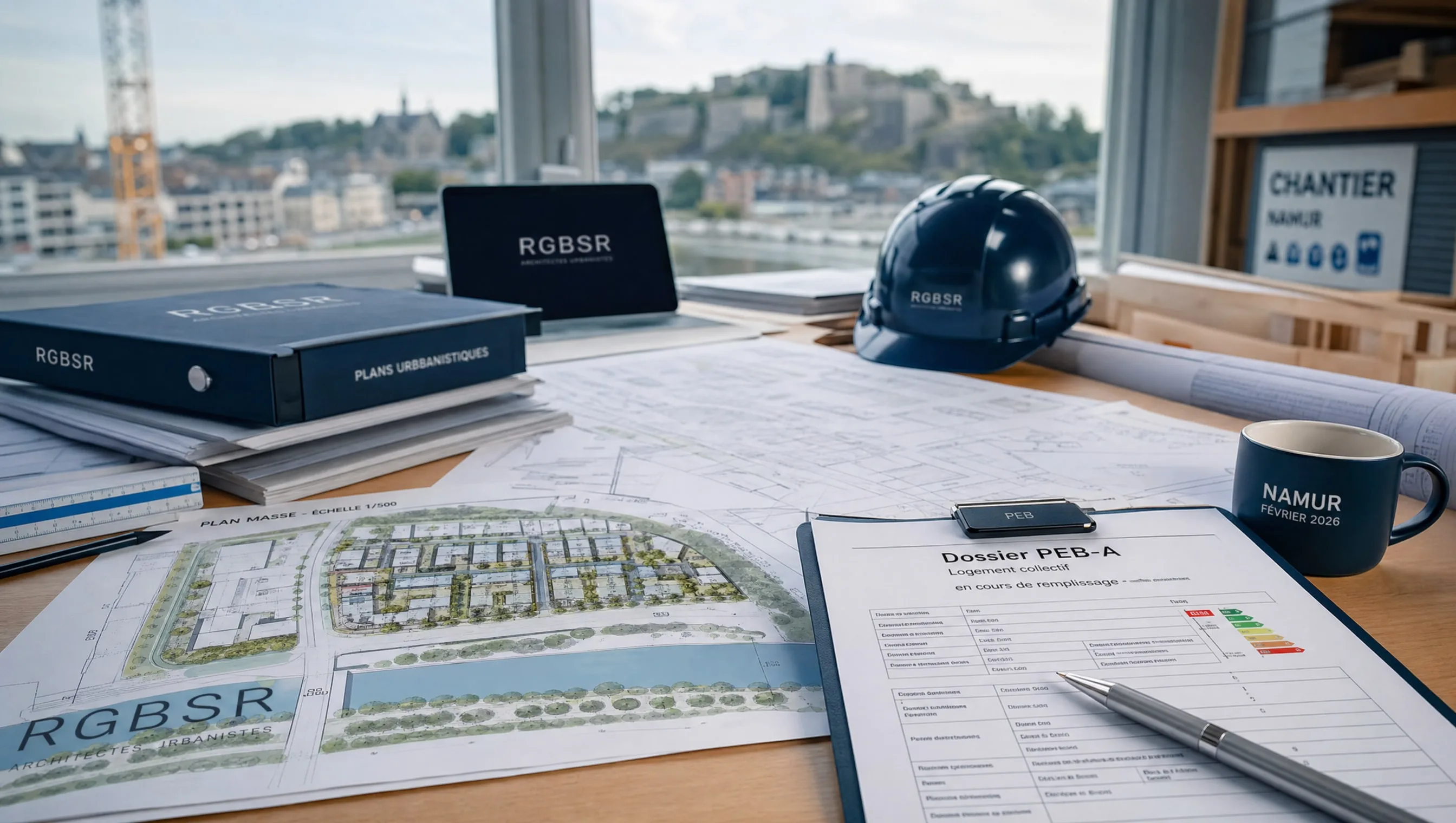
The year 2026 marks the convergence of three major texts in Wallonia that overhaul the regulatory framework for residential construction. If you are receiving a house this year whose permit dates from 2024 or 2025, you are caught between two regimes — and that is rarely to your advantage. Here is what to understand of the new PEB-A obligations, the RGBSR overhaul, and the reinforced application of the RRU in the 24 priority municipalities.
PEB-A mandatory for new-build residential
Since 1 January 2026, any new residential construction whose permit is later than June 2025 must reach energy class PEB-A (Espec ≤ 85 kWh/m²·year). This is a significant jump from the PEB-B threshold in force until 2025 (170 kWh/m²·year). Concretely, the new technical requirements are:
- Roof insulation R ≥ 5 m²·K/W (equivalent to 20 cm mineral wool + vapour barrier)
- External wall insulation R ≥ 4.5 m²·K/W (16 cm PIR or 18 cm rockwool)
- Triple-glazed joinery Uw ≤ 1.0 W/m²·K
- Heat-recovery MHRV with efficiency ≥ 85%
- Air-tightness n50 ≤ 1.5 vol/h (Blower Door test mandatory at reception)
At the provisional reception, demand the final PEB certificate signed by an approved assessor. Without this document, you cannot resell, obtain certain municipal grants, or invoke ten-year liability on energy performance. The cost of a PEB certification is between €350 and €550 — generally at the contractor’s expense in standard turnkey contracts.
RGBSR revised in March 2026
The General Regulation on Buildings in Rural Sites (RGBSR) was amended in March 2026 by Walloon Government decree. Practical consequences on the sites I review:
- New scale rules for agricultural zones (cornice height limited to 4.5 m)
- Reinforced constraints on facade materials in classified sites (restricted palette)
- Rainwater tank ≥ 5,000 L mandatory for any new build outside urban zones
- Permeable surface minimum 30% of the plot
- Strengthening of native plantings at plot boundaries
For ongoing sites whose permit predates March 2026, these new rules do not apply retroactively. But they may be imposed if you request a modifying permit during the works.
RRU: reinforced application in urban zones
The Regional Urban Planning Regulation has been reinforced in the 24 priority municipalities since April 2026. In Brussels, the RRU has long been applied. In Wallonia, the municipalities concerned notably include Liège, Charleroi, Mons, Namur, Tournai, Verviers, La Louvière, Mouscron and dense peripheral municipalities.
Points to verify at reception in these zones:
- Facade compliance with the authorised scale (geometer survey if doubt)
- Cornice heights identical to the submitted plans
- Treatment of outdoor spaces visible from the public road
- Material consistency with the permit (cladding, roof, joinery)
A defect can block final reception if the urban-planning department refuses the compliance certificate. I have a case in Liège in 2025 where a non-compliant joinery colour delayed the release of the retention guarantee by 8 months.
The cumulative effect of the three texts in 2026
For sites started late 2025 and received in 2026, you may potentially be affected by the three texts simultaneously:
- PEB-A if the permit is after June 2025
- Revised RGBSR if the modifying permit was filed after March 2026
- Reinforced RRU if you are in a priority municipality
This superposition creates zones of uncertainty that I see come back almost every week in the cases I handle. I systematically advise requesting an intermediate urban-planning compliance certificate before final reception.
Pitfalls to avoid
- Don’t sign the minutes without the final PEB in hand
- Check the new 5,000 L tank requirements if you are outside urban zones
- Request urban-planning compliance from the municipality before final reception
- Beware of contracts dated 2024-2025 that don’t mention PEB-A
For details of the official Walloon texts, see the portals energie.wallonie.be and urbanisme.wallonie.be.
What next?
If your permit dates from 2024-2025 and the reception is approaching in 2026, have your file’s compliance validated by a third-party expert. My practice offers a construction audit that includes verification of the new PEB-A thresholds and RGBSR/RRU compliance.