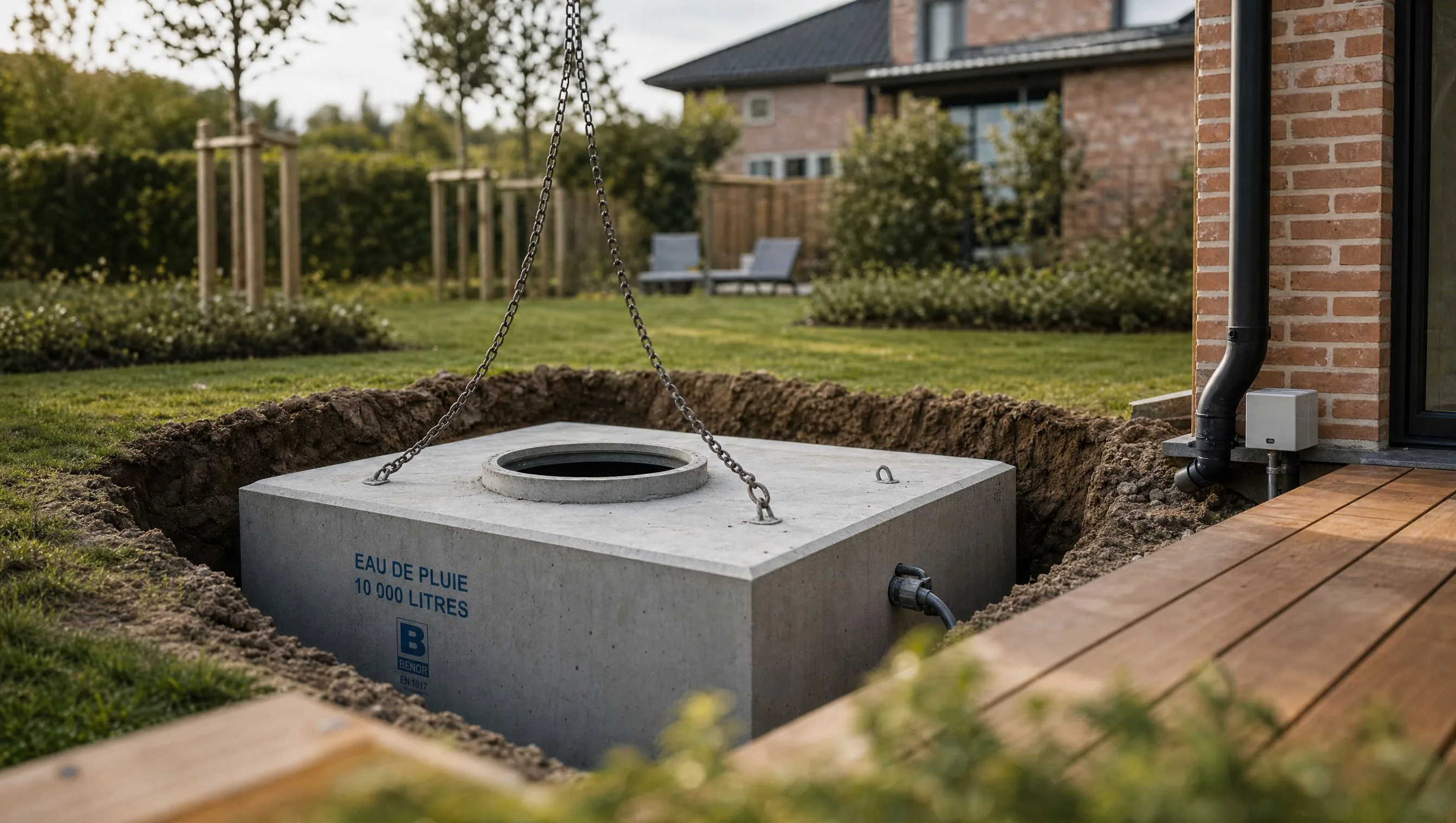
In Wallonia since 2023, every new construction must include a rainwater tank. The minimum volume rose from 3,000 to 5,000 litres on 1 January 2026 for single-family homes, with additional rules in rural zones. This obligation, still poorly known by many buyers and even some contractors, has become a systematic check point in my provisional receptions. Here is what it concretely changes at the time of reception, and the common pitfalls I see recur.
The regulatory volume and sizing
Legal thresholds in Wallonia 2026:
- House with less than 100 m² of roof: minimum 5,000 L
- Beyond 100 m² of roof: 50 L per m² of projected sloped roof area
- Rural zone (RGBSR): 5,000 L minimum regardless of area
- Collective housing: specific rule per unit, see municipal regulation
A villa with 180 m² of roof therefore requires 9,000 L minimum, and in practice many experts recommend 10,000 L to gain 6 to 8 months of autonomy on compatible uses (WC, washing machine, garden, car wash).
The cost of a 5,000 L tank installed ranges between 2,800 and 4,500 € depending on the material (HDPE, polyester, concrete) and the complexity of the burial. A 10,000 L costs 4,200 to 6,800 €.
Mandatory connections
The rainwater tank is only useful if correctly connected to compatible uses:
- WC flush fed by rainwater via a separate clearly identified network (colour, permanent marking)
- Outdoor garden tap on the rainwater network
- Possibility to connect washing machine (filtration required)
- Booster pump sized correctly (1.1 bar minimum, 3.5 bar maximum)
- Cartridge filter upstream of the pump
- Overflow directed to the public network or a soakaway, with mandatory non-return valve to avoid sewer back-flow
The “non-potable water” marking on all concerned pipes is a firm sanitary obligation. A tank without marking is non-compliant, even if the system works.
Reception checks
On the sites I inspect, this is the systematic check-list for the tank:
- Actual measured volume (often lower than announced on plastic tanks)
- Tank watertightness tested in water during the site phase
- Inlet strainer to block leaves and debris
- Functional overflow correctly oriented
- Pipe marking “non-potable water” compliant
- EPC integrating the tank in the energy calculation
- Booster pump adjusted and tested
- Non-return valve present and functional
- Access hatch watertight and accessible for maintenance
- Annual maintenance sheet handed to the owner
Municipal subsidies
Several Walloon municipalities grant additional subsidies for tanks beyond the legal minimum:
- Municipal subsidies: 300 to 1,200 € depending on volume and municipality
- Regional planning subsidy: variable by zone (notably RGBSR)
- EPC bonus: an integrated tank improves the energy calculation
For details on Walloon energy subsidies, see energie.wallonie.be — subsidies.
Wavre 2025 case: insufficient volume
A Wavre client contacted me in January 2025 after receiving a planning formal notice: her new tank held 3,200 L instead of the 5,000 L required since 2023. The builder had proposed a 1,800 € amendment to bring it up to standard. After expertise and invocation of Article 9 of the Breyne Law (defect affecting legal compliance), the contractor took full charge of the replacement: 3,800 € for the new tank and restoration of the garden.
Pitfalls to avoid
- Don’t settle for nominal volume: demand usable volume
- Check the permanent marking “non-potable water” on the pipes
- Beware of tanks installed without documented watertightness test
- Keep the technical sheet and invoice for 10 years
- Schedule annual maintenance (strainer cleaning, pump check)
What’s next?
If your reception is coming and you doubt the compliance of your tank, have it validated by a third-party expert. My practice systematically includes the tank check in the provisional reception expert mission, or request a free quote for a one-off audit.