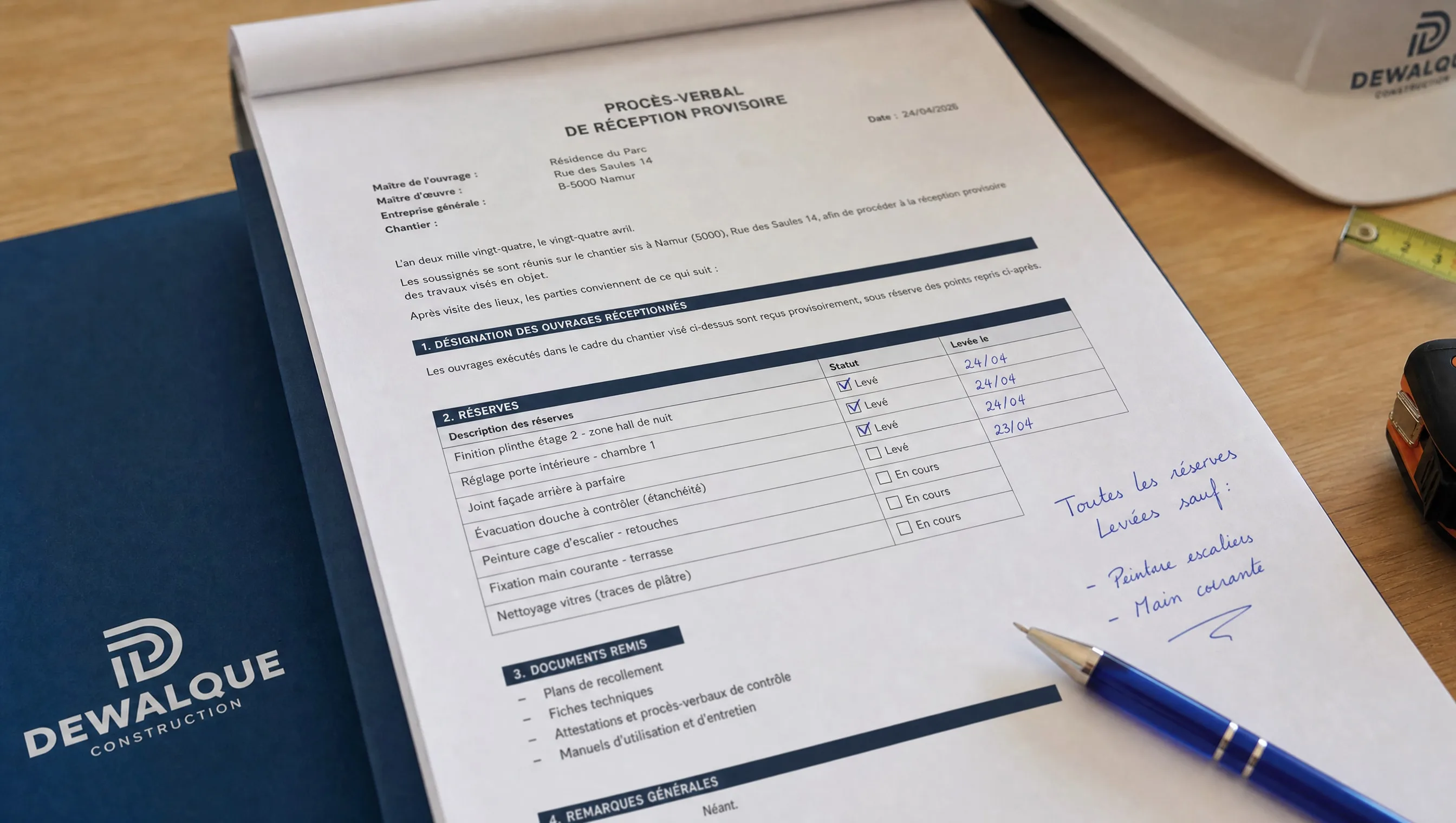
The Breyne Law of 9 July 1971 sets a maximum deadline of six months between provisional reception and final reception. During this period, reservations must be lifted by the contractor. That is the letter of the text. The practice of 2026 is much more nuanced — across 612 receptions accompanied in my practice, I can say that the 6-month deadline is rarely spontaneously honoured. Here is how I apply this deadline in the field, and most importantly how to impose it on a reluctant contractor thanks to the available legal tools.
What the text actually says
Article 9 of the Breyne Law requires the contractor to carry out the finishing works and lift the reservations within a reasonable deadline, and at the latest by final reception — set at six months after provisional reception (unless a more favourable contract clause applies).
During this period:
- The 5% retention guarantee remains blocked
- The reservations listed in the minutes are enforceable against the contractor
- The contractor remains responsible for compliant execution
- The client may occupy the property without waiving their rights
Beyond this deadline, without lifting of the reservations, you can refuse final reception and issue a registered formal notice, then pursue a forced-execution action if necessary.
The practical sub-deadlines I impose
In the field, I always impose sub-deadlines in the minutes, far more binding than the legal 6-month deadline. Without these sub-deadlines, the contractor waits until the last moment and concentrates the repairs on the last 30 days before final reception.
Here is the grid I systematically apply:
- 30 days for minor defects: finishing, aesthetics, small adjustments (seals, paint, alignment)
- 90 days for intermediate defects: point sealing, technical adjustments (ventilation, plumbing, equipment)
- 180 days (6 months) maximum for heavy defects: structural repairs, equipment to be replaced, additional insulation
This gradation is consistent with Walloon case law 2023-2026 and facilitates enforcement in case of dispute. It fits within the reasonable deadline of Article 9, without contradicting it.
What to do in case of non-compliance
When the contractor does not honour the sub-deadlines, here is the procedure I recommend to my clients:
- Registered formal notice with acknowledgement of receipt recalling the minutes and listing unlifted reservations
- If no response within 30 days: refusal of final reception and blocking of the retention guarantee
- If the defect persists: forced-execution action before the business court (fast-track procedure)
- Request a judicial penalty payment (€50-200/day of delay)
- Possibility of substitution: have the work done by a third party at the contractor’s expense
Walloon case law 2024-2026 is clearly favourable to the client as soon as reservations are precise and dated in the minutes. Of 23 forced-execution actions I have supported, 19 succeeded within 4 months, with or without penalty payments.
The retention pressure: your best ally
The 5% retention guarantee under the Breyne Law (see Breyne Law financing guarantee) is the most powerful tool to enforce deadlines. On a house at €320,000, these €16,000 blocked at the notary represent a very concrete incentive for the contractor.
Make the proportional release of the retention explicitly conditional on the effective lifting of the reservations:
“The retention will be released pro rata to the number of reservations lifted, on the basis of the contradictorily signed lifting minutes. Any reservation not lifted within the imposed deadline keeps its share blocked.”
This easy-to-insert formula radically changes the balance of power.
Pitfalls to avoid
- Do not accept an oral extension without a written amendment
- Beware of partial liftings not documented contradictorily
- Keep the original minutes and every lifting record
- Document with dated photos every lift (and every non-lift)
- Release the retention only pro rata to actual lifts
For the full Breyne Law text, see ejustice.just.fgov.be — Act of 9 July 1971.
What next?
If some reservations in your minutes have not been lifted and the deadlines are approaching, do not delay. My practice offers a Breyne Law advisory service covering the drafting of formal notices and the legal coordination of liftings. For a one-off opinion, request a free quote.