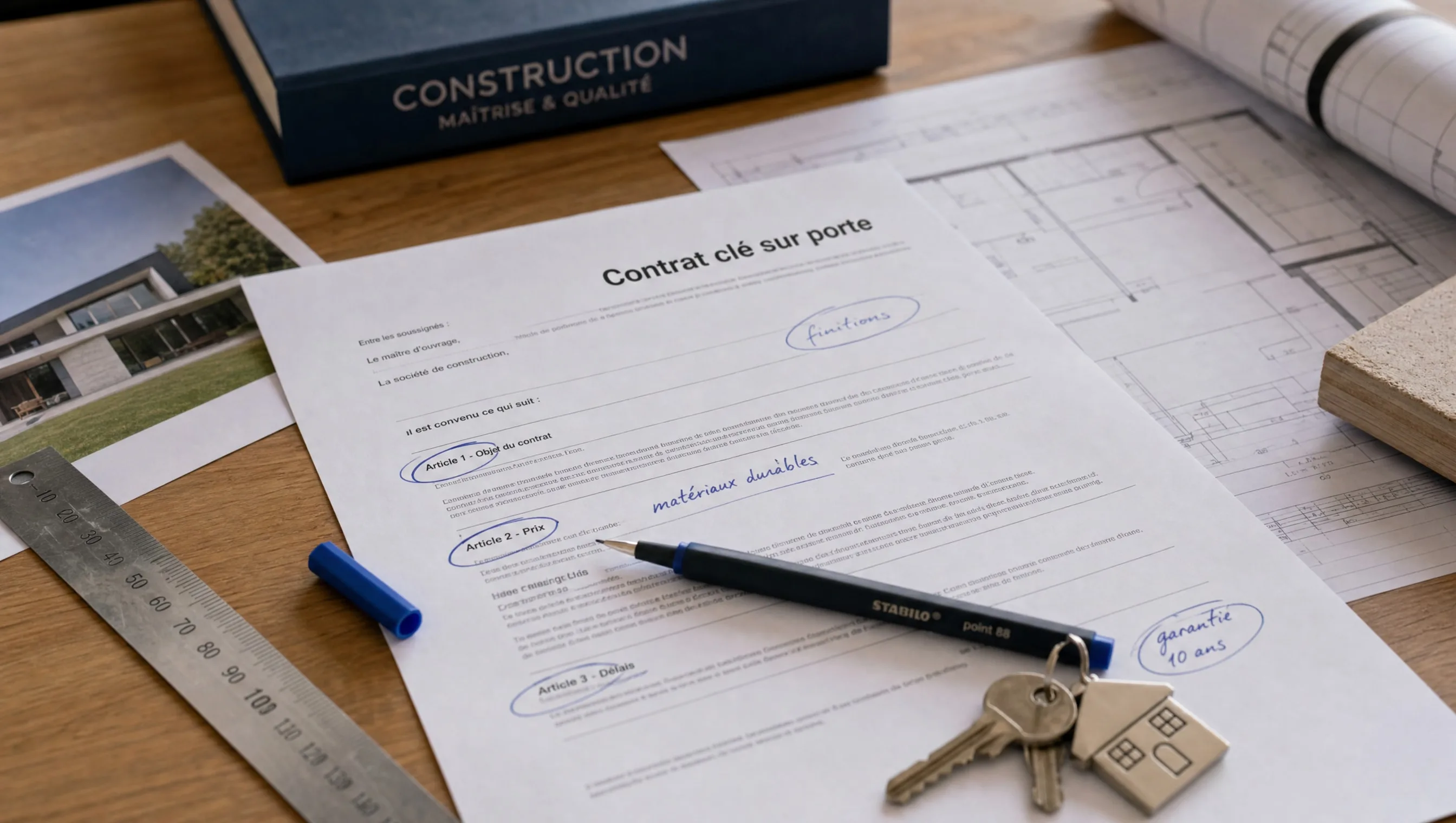
I have reviewed more than 400 turnkey contracts since 2021 in my practice. Major Walloon builders’ contracts run 40 to 60 pages, and 80% of disputes I deal with afterwards stem from 12 identical clauses that recur almost unchanged from one builder to another. Decoding these 12 clauses means shielding yourself from the vast majority of post-reception conflicts. Here is the section-by-section decoding, with the precise requirements to formulate before signing.
The 4 price and financing clauses
1. “Price” article
Fixed or revisable? Favour the fixed price with an indexation clause capped at 3% annual maximum in 2026. The index used must be ABEX type II or an equivalent official index. A clause without a cap can drift the budget by 8-12% over six months during inflation.
2. “Down payments” article
Aligned with actual progress, never with a fixed calendar. Article 7 of the Breyne Law caps payments at 5% at signing, 15% at start, 45% at closed shell, 30% at finishing, 5% at final reception. Any more aggressive schedule is unlawful.
3. “Late penalties” article
Minimum €50/day with an unambiguous completion date. Check the starting point (firm contractual date), the cap (typically 10% of the price), and the automatic character (no prior formal notice required).
4. “Suspensive conditions” article
Permit, financing, sale of current property — deadlines and procedures specified. Without well-drafted suspensive conditions, you commit your deposit with no recourse if the unexpected occurs.
The 4 technical and material clauses
5. “Specifications” article
Must be annexed and signed page by page, not merely referenced. See the article construction specifications for the 9 critical sections. Unsigned specifications are not enforceable.
6. “Modifications” article
Pricing method for credits and extras, ideally at unit prices displayed in the contract. Without a unit-price grid, every modification becomes a negotiation where you are in a weak position.
7. “Material substitution” article
Must require the prior written agreement of the client, not a mere notification. This often overlooked clause shields you from downward substitutions during the build (“equivalent” references).
8. “Excluded items” article
Exhaustive list with indicative estimated amounts. Without this list, you discover “unforeseen” extras at every step. See the article unexpected construction budget.
The 4 warranty and reception clauses
9. “Ten-year liability” article
Insurer name, covered amount, and copy of the certificate annexed. Without the original certificate, the ten-year cover is legally fragile. See the article selling with ten-year liability.
10. “Provisional reception” article
Modalities, mandatory presence of the client’s expert (clause to add if absent), timed reservation-lifting procedures (30 days minor, 90 days major).
11. “Final reception” article
Minimum 6-month delay after provisional, conditions for release of the retention guarantee (5% Breyne Law). See the article Breyne Law financing guarantee.
12. “Disputes” article
Jurisdiction at the client’s domicile (prefer over contractor’s registered office), mandatory prior mediation before judicial action. This clause facilitates amicable resolution of minor disputes.
Pitfalls to avoid
- Never sign without having read the annexes in full (often 80-120 pages)
- Refuse pre-printed non-modifiable contracts
- Beware of oral promises: only the text counts
- Check completion guarantee registration (Breyne Law obligation)
- Keep the signed original in a separate location
For the full Breyne Law text, see ejustice.just.fgov.be — Act of 9 July 1971.
What next?
No clause in this contract is neutral: each one protects one of the two parties, never both. Ask your expert to identify those that harm you — usually four to six out of the twelve. My practice offers a Breyne Law advisory that includes full contract review and a clause-by-clause synthesis report.