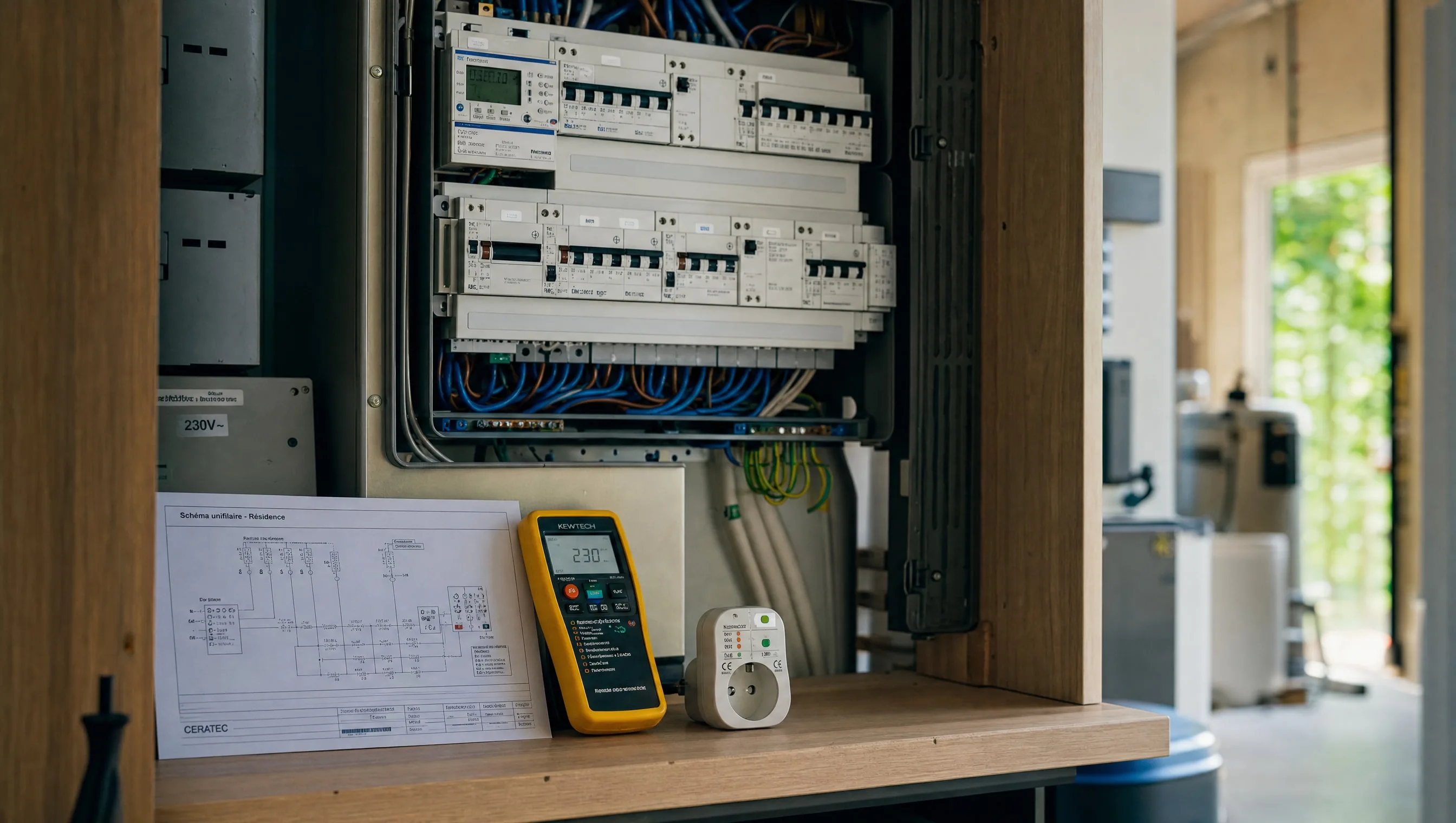
The RGIE (General Regulation on Electrical Installations) inspection is mandatory and necessary before any reception. It is not sufficient. In 2026, across the 120 receptions where I encountered a compliant RGIE report in my practice, I recorded an average of 4.6 defects that slipped under the radar of the accredited inspector. Why? Because the RGIE checks regulatory compliance (electrical safety, earthing, residual-current devices), not execution quality (aesthetics, ergonomics, finishes). Here is the exhaustive 23-point checklist I systematically use for every provisional reception.
Panel and wiring (8 points)
The electrical panel is the heart of the installation. Systematic checks:
- Labelling of each breaker, legibility, consistency with the single-line diagram
- Presence of the diagram inside the panel or in immediate vicinity
- 30 mA residual-current devices on all socket and bathroom circuits
- Cable cross-section consistent with power and distance (1.5 mm² lighting, 2.5 mm² sockets, 6 mm² oven)
- Earthing visible with electrode testable by megohmmeter
- Cabinet locking by key or tool (child safety standard)
- Reserve of at least 20 % spare breakers for future evolutions
- Single- or three-phase incomer correctly sized for intended use (typically 25 or 40 A)
Also visually check tidiness: a well-wired panel is a well-thought panel. Cables in disorder = rushed electrician = probable hidden defects.
Sockets, switches and light points (9 points)
Ergonomics and compliance in all rooms:
- Standardised height 30 cm for common sockets, 110 cm for switches (except PMR accessibility prescription at 90 cm)
- Vertical alignment of fittings (aesthetic, check with spirit level)
- Polarity tested at every socket with a 5 € tester (live, neutral, earth)
- Presence of a switched socket in every bedroom (2026 comfort standard)
- Smoke detectors connected to 230 V with backup battery (RGIE mandatory)
- Roof outlet for the fan or the ventilation unit
- Functional light points and oriented (two-way vs simple switches)
- Junction boxes accessible and labelled
- Equipotential bonding in the bathroom (bath, washbasin, shower)
For details on RGIE non-compliance and recourse, see the article non-compliant electrical reception.
Outdoor and specific (6 points)
Often neglected areas that cause long-term problems:
- Outdoor sockets IP44 minimum, with watertight cover
- Outdoor lighting on detector or centralised indoor switch
- Electric vehicle charging point if planned (power, wiring, certification)
- General cut-off accessible and identified (mandatory for fire services)
- Smart meter Ores or Resa installed and functional
- Wiring reserve for photovoltaic panels (2026 recommendation)
Documents to require at the minutes
Beyond the physical check, four documents are indispensable to request at the moment of reception:
- Compliant RGIE report signed and stamped, in original
- Detailed single-line diagram of the installation
- Technical sheets of the equipment (panel, breakers, specific sockets)
- Manufacturer’s warranty on panel components (typically 5 years)
Without these four documents, your electrical file is incomplete and the ORES commissioning will be blocked.
Tools to bring on the day
For the complete electrical checklist, the kit to bring:
- Socket tester (7-12 €)
- Basic digital multimeter (20-30 €)
- Headlamp (10-15 €)
- Tape measure 3 m (5 €)
- Smartphone with compass and level app
Total investment: less than 60 €, to be amortised over all the property purchases of your life.
Pitfalls to avoid
- Don’t settle for RGIE alone: it does not cover execution quality
- Check the reserve circuits: a panel without reserve is a saturated panel
- Beware of rushed finishes: suspect handwritten labelling
- Test the outdoor sockets: frequent oversight (missing cover)
- Keep the original RGIE report for at least 10 years
For the full regulatory framework of residential electricity in Belgium, see economie.fgov.be — technical electrical rules.
What’s next?
If you want to secure the electrical part of your provisional reception, my practice offers a dedicated electrical expertise covering the 23 points above and coordination with the accredited inspection body.