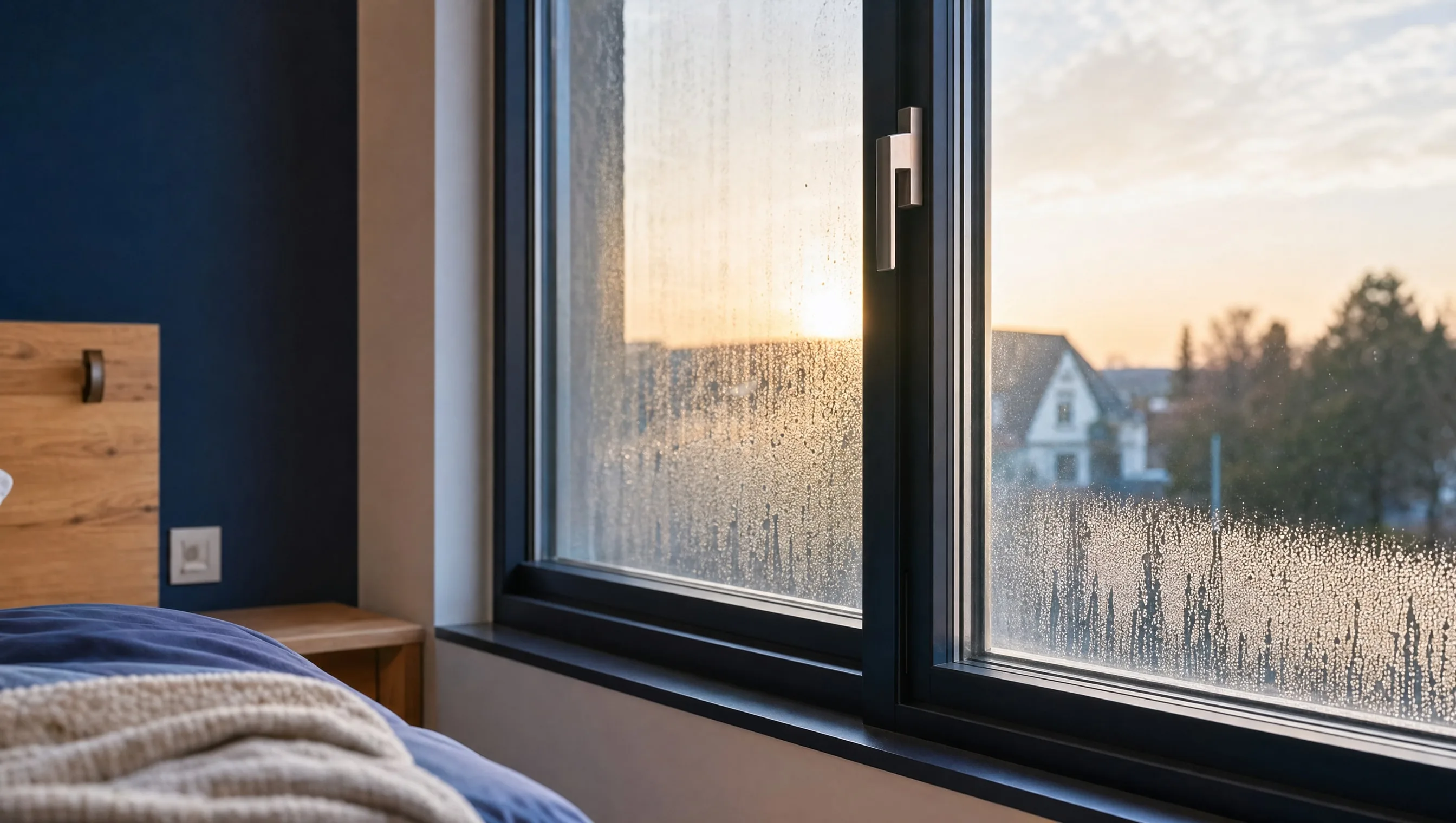
The Demoulin family calls me in March 2026. New-build home received in May 2025, daily condensation on every window upon waking since autumn. The contractor replied with a curt email: “It’s normal for a new build, residual moisture evaporates over 18 months, ventilate more.” The answer is partly true. And largely insufficient. Here is how to tell normal condensation apart from a defect covered by the Breyne Law, and the story of this case which ended with a full overhaul of the ventilation under the two-year warranty.
What is genuinely normal
A new-build construction actually contains 5,000 to 10,000 litres of residual water (concrete, mortar, plaster, paint, glues). This water evaporates progressively over 12 to 18 months depending on materials and ventilation. During this period, light morning condensation in winter is possible, especially in wet rooms (kitchen, bathrooms) and on the coldest glazing.
The simple test to tell normal from pathological:
- Morning condensation gone before 11 a.m. with no intervention: normal
- Localised condensation on 1-2 north-facing windows: tolerable
- No lasting marks on frames, seals or walls: normal
- Indoor humidity between 45 and 65% RH: normal
- Progressive decrease observed month after month: normal
For the record, the full drying time of a new-build house is 12-18 months — see the article new house drying time for the detail by material.
What is no longer normal
Four signals indicate a structural technical defect, not mere residual moisture:
- Persistent condensation all day, not clearing with ventilation
- Black runs on frames or walls (incipient mould)
- Internal moisture between the two panes of glazing (sealed unit failure, covered by product warranty)
- Appearance in summer in dry weather (ventilation problem, not residual moisture)
- Appearance on perimeter walls in the upper section: sign of a structural thermal bridge
On 6 condensation cases I assessed in 2026, 4 were enforceable defects. Total compensation obtained: €38,400.
The diagnosis to request
When I’m called on a condensation case, I always follow the same protocol:
- Thermal imaging camera in winter to visualise thermal bridges (outside temperature < 8°C required)
- Hygrometer in several rooms to measure humidity (above 65% continuously is abnormal)
- Verification of actual ventilation operation: flow rates measured at each vent, not just “it runs”
- Extraction flow measurement in the kitchen (≥ 30 m³/h) and bathroom (≥ 15 m³/h)
- Smoke test to verify flow direction
Total diagnostic cost: €350 to €550 ex VAT. Compare with the average cost of a ventilation overhaul under warranty: €6,000 to €12,000. The cost-benefit ratio is immediate.
Legal recourse depending on the cause
If condensation stems from a technical defect, several routes are available depending on the nature:
- Unset ventilation: two-year warranty (2 years), repair at contractor’s expense
- Structural thermal bridge: ten-year liability (10 years), heavy repair
- Faulty air-tightness: two-year warranty, contradictory Blower Door test
- Faulty glazing: product warranty (5-10 years depending on manufacturer)
- Insufficient insulation: ten-year if it affects habitability
Of 612 receptions accompanied, around 12% show ventilation defects detected within 24 months of reception. Ventilation is the most neglected piece of equipment at commissioning.
Pitfalls to avoid
- Do not accept “it’s normal, ventilate more” without a diagnosis
- Beware of oral answers with no formal letter
- Document the condensation with dated photos over 2-3 months
- Measure humidity with a digital hygrometer (€15)
- Run the test in winter: condensation is invisible in summer
For Belgian ventilation standards, see BBRI — Belgian Building Research Institute.
What next?
If you observe persistent condensation in your new-build home, do not let it drag on. The two-year warranty lasts only 2 years, and defects not documented before that deadline become irrecoverable. My practice offers a dedicated ventilation expertise, or a broader Breyne Law advisory.