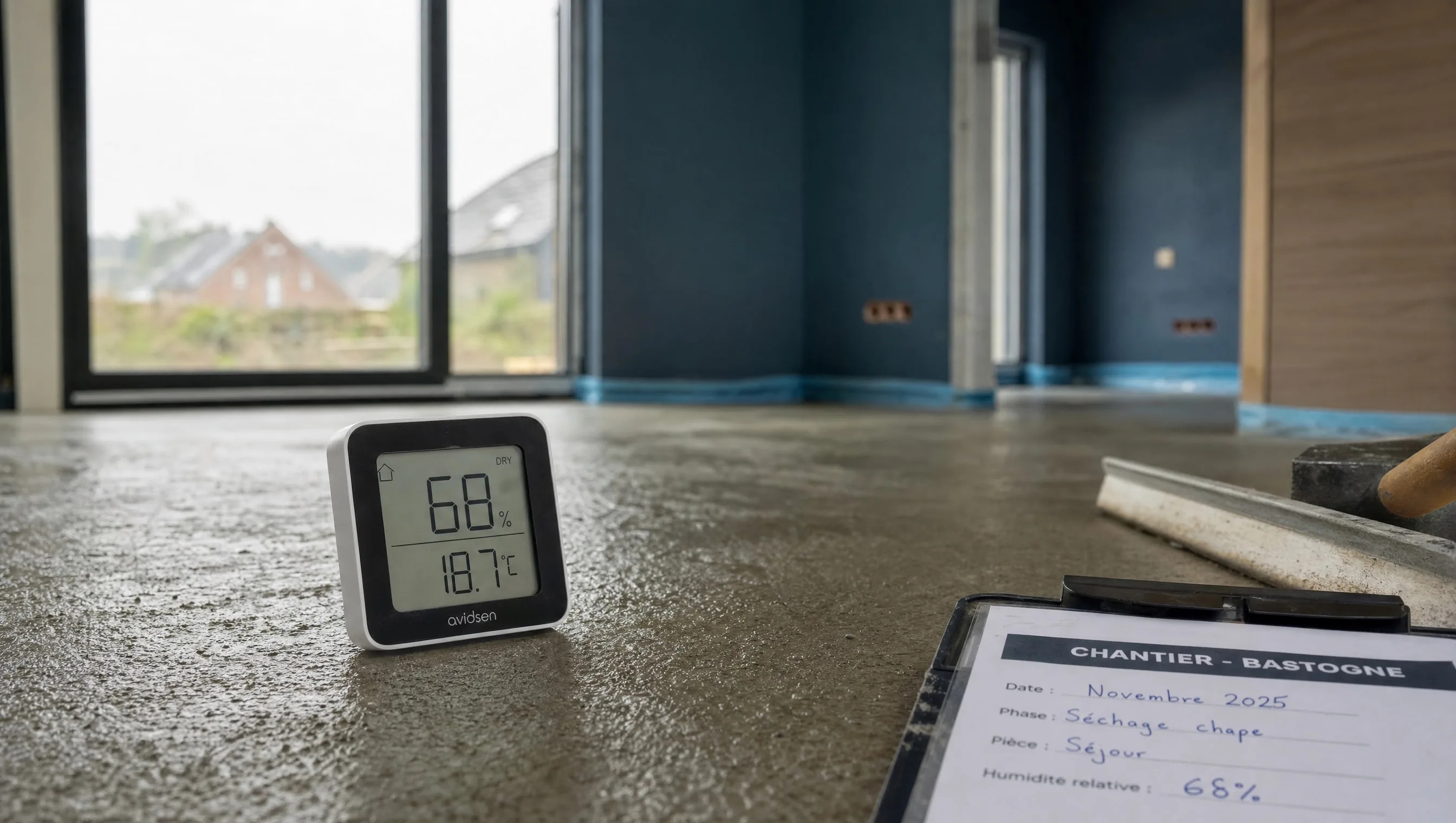
A question that comes up every month at receptions in my office: “when can we move in?”. Long answer: it depends on the materials used, the ventilation system, the heating method, outside conditions. Short answer: not before 6 months minimum after closing the shell. A 150 m² new build evaporates on average 3,800 to 4,200 litres of water in the 12 months following shell closure, the equivalent of 25 water bottles per day. Understanding the drying time of a new build avoids many defects (condensation, mould, shrinkage cracks) that appear within the first 18 months.
The real drying table by material
Here are the average drying times observed on the sites I assess:
- Standard cement screed: 1 cm = 1 week, i.e. 6 to 8 weeks for 6 cm
- Anhydrite screed (calcium sulphate): 1 cm = 1 day for the first 4 cm, then 2 days/cm
- Reinforced structural concrete: 28 days for 90% of strength, but deep drying takes 6 to 12 months depending on thickness
- Interior plasters: 4 to 6 weeks depending on ventilation
- Exterior cement renders: 4 to 8 weeks frost-free
- Masonry bedding mortar: 4 to 12 weeks depending on season
- Acrylic paints: 7-14 days for full drying, 3 months for chemical stabilisation
- Floor varnishes and adhesives: 4-12 weeks depending on product
These times must be multiplied by 1.5 in winter or damp weather, and may be divided by 1.3 in dry summer with active mechanical ventilation.
The residual moisture we forget
A 150 m² new build evaporates on average 3,800 to 4,200 litres of water in the 12 months following shell closure. If the ventilation system is wrongly set or you move in with heating on full from delivery, this water migrates to cold zones and condenses:
- Mould in wall corners (black film at the top)
- Black marks behind furniture against external walls
- Persistent cold-air sensation despite the heating
- Condensation on windows in the morning (see new house condensation)
- Localised paint blisters
- Shrinkage cracks in plasters and renders
Test before laying tiles or parquet
Before any moisture-sensitive floor covering (glued parquet, vinyl, large-format tiles), check the residual moisture of the screed with the carbide method or a professional hygrometer.
Maximum acceptable thresholds:
- Glued parquet: ≤ 2% (cement screed), ≤ 0.5% (anhydrite screed)
- Vinyl: ≤ 2.5%
- Large-format tiles: ≤ 3%
- Floating laminate: ≤ 3.5%
Above these thresholds, wait. Premature laying may cause:
- Parquet lifting within 6-12 months
- Blisters under vinyl
- Cracked tile joints
- Loss of product warranty
The ideal move-in calendar
On the projects I support, here is the chronology I recommend:
- Shell closure (watertight): drying starts
- + 3 months: interior plasters and screeds laid
- + 6 months: floor coverings laid (after hygrometric test)
- + 7 months: paint and finishes
- + 9 months: ideal provisional reception
- + 12 months: full stabilisation, optimal move-in
Pitfalls to avoid
- Do not heat above 19°C for the first 6 months
- No furniture against external walls the first year
- Measure humidity with a digital hygrometer (€15)
- Systematically air 10 min morning and evening, even in winter
- Check the ventilation on boost for the first 12 months
For the technical drying standards of materials, see BBRI — Belgian Building Research Institute.
What next?
If you are about to move in and fear drying-related defects, have your house diagnosed by an independent expert 6 months post-reception. My firm offers a dedicated moisture expertise, or a broader provisional reception expert service.