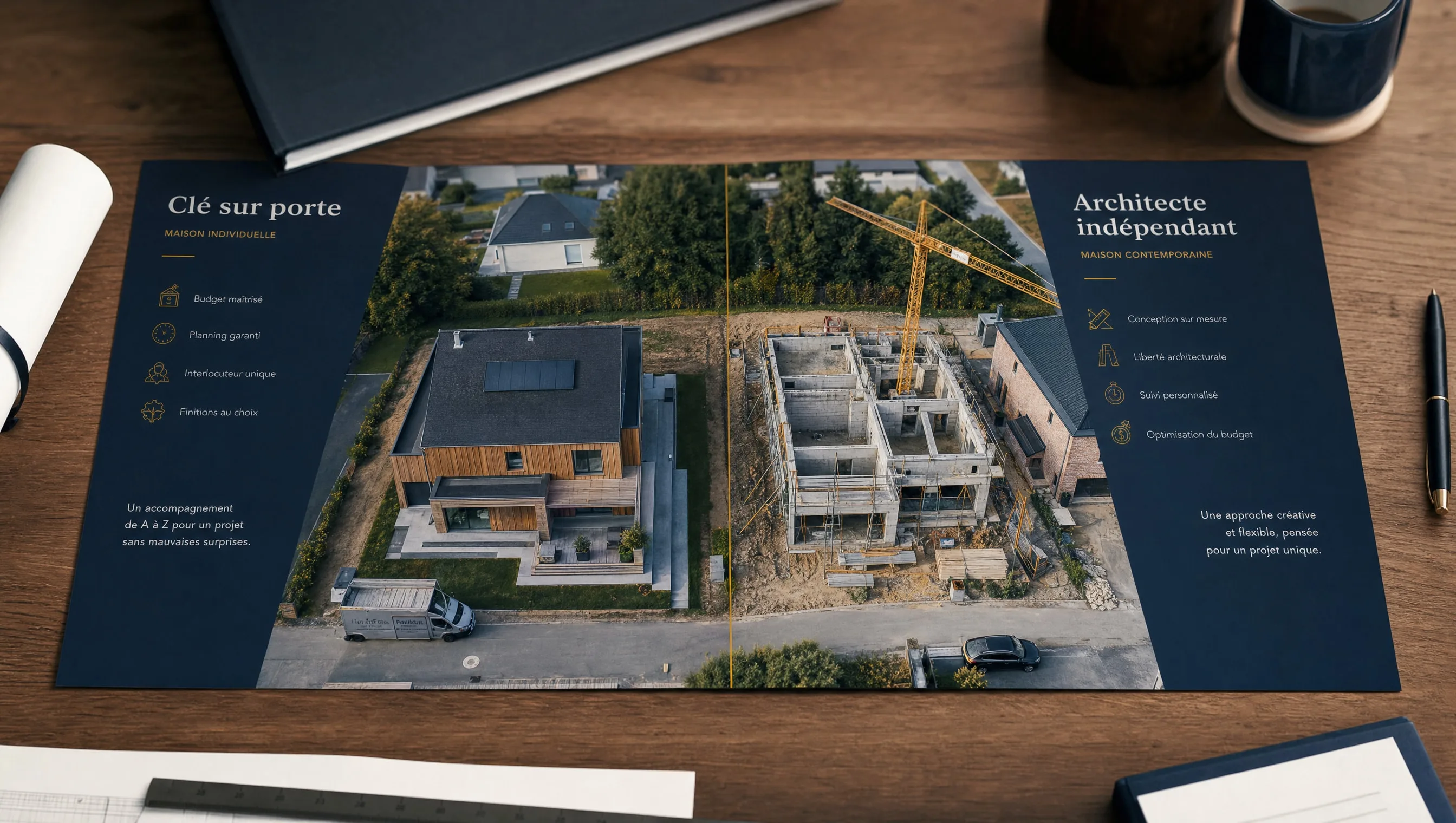
I support as many clients in turnkey as with an independent architect in my practice. Both schemes have their successes and their shipwrecks. Across 80 recent sites I have expert-reviewed, what distinguishes the two is not the final quality: it is the budget predictability, the personalisation margin and the typical dispute profile. The debate is ill-posed when framed as a quality duel. It is in reality a choice of governance and risk exposure. Here is how to decide without regret in 2026.
Turnkey: fixed price, reduced margin
The great advantage of the turnkey contract is financial legibility. One interlocutor, one contract, an announced price that — in practice — drifts by 5 to 10 % on average, versus 12 to 22 % under architect-led builds. The flip side is threefold:
- Little room for material choices (restricted catalogue)
- Costly modifications (50 % more than in direct contracting)
- Specifications often “standardised low” (averaged middling quality)
Frequent disputes concern material equivalence (“equivalent” references), delivery deadlines, and post-reception finishes. See the article turnkey contract clauses for details of the clauses to verify.
Turnkey is particularly suited to:
- First-time buyers with no site experience
- Active couples with no available time
- Buyers who prioritise budget security
Architect: fine piloting, exposure to risk
With an independent architect and separate contractors, you keep control over each trade, aesthetic choice is total, and value for money on materials is generally better (15-25 % savings on premium materials).
But you manage 12 to 18 different contractors, the default risk of any one of them falls back on you, and coordination demands at least 80 to 120 personal hours over the duration of the site. The most common disputes concern interfaces between trades — who pays when the tiler damages the paint laid the day before by the plasterer?
The architect is particularly suited to:
- Experienced owners or those who have already built
- Self-employed with time flexibility
- Atypical projects (heavy renovation, eco-construction, strong design)
- Budgets above 450,000 € with qualitative requirements
The decisive criterion in 2026: your available time
The most structuring criterion is neither the budget nor the aesthetics, but the monthly available time for the site.
My decision grid after 80 cases:
- < 10 h/month: turnkey mandatory (otherwise, certain drift)
- 10-20 h/month: turnkey with audit by a third-party expert
- 20-40 h/month: hybrid piloting (independent coordinator or architect on design + general contractor)
- > 40 h/month: direct architect profitable
Between the two, a hybrid piloting with an independent coordinator may be the best option — that is what I offer in the construction audit mission.
The synthetic comparison
For a 320,000 € (excl. VAT) house in 2026, here are the comparative figures:
- Turnkey: average final price 336,000 €, i.e. +5 %
- Architect: average final price 358,000 €, i.e. +12 %
- Hybrid: average final price 342,000 €, i.e. +7 %
But the resale value at 5 years:
- Standard turnkey: 290,000-310,000 € (standard depreciation)
- Architect with strong design: 340,000-380,000 € (architectural premium)
- Well-piloted hybrid: 320,000-355,000 €
The choice therefore also depends on your resale horizon.
Pitfalls to avoid
- Don’t be seduced by the 3D rendering without validating the specifications
- With an architect, reserve 15 % margin for unforeseen
- With turnkey, list quantified exclusions in the specifications
- Plan a third-party expert at reception whatever the scheme
- Compare dispute profiles by typology, not commercial promises
For official statistics, see statbel.fgov.be — construction and housing.
What’s next?
If you hesitate between the two schemes, have your project validated by a third-party expert before signing any contract. My practice offers Breyne Law support covering both schemes, or a construction audit for hybrid piloting.