The question comes up every month in my practice: “Why am I being asked for an asbestos diagnosis when my house is new?” In 2025, I dealt with 73 such files — about 12% of the provisional receptions I support. The natural reflex is to think it is an administrative error, but the reality is more nuanced. Here is what Belgian law says, what happens in practice, and how to read the mention when it appears on your minutes.
Asbestos has been banned in Belgium since 1998
All manufacture, placing on the market and use of asbestos is prohibited by the Royal Decree of 23 October 2001, transposing European directive 1999/77/EC. In concrete terms, a building constructed after 2001 cannot contain new asbestos. If your home rises in 2024 on a virgin plot, you have no legal diagnosis obligation — full stop. Belgian legislation is among the strictest in Europe: even holding asbestos material for resale is punishable by criminal fines.
In practice, I see panicked emails from buyers every year about an “asbestos clause” in their preliminary sale contract. In 80% of cases, it is a boilerplate clause inserted out of habit by certain notaries that simply does not apply to pure new construction. Ask your notary to specify in writing the legal basis for the clause — you will most often get an outright withdrawal.
But the land itself may be contaminated
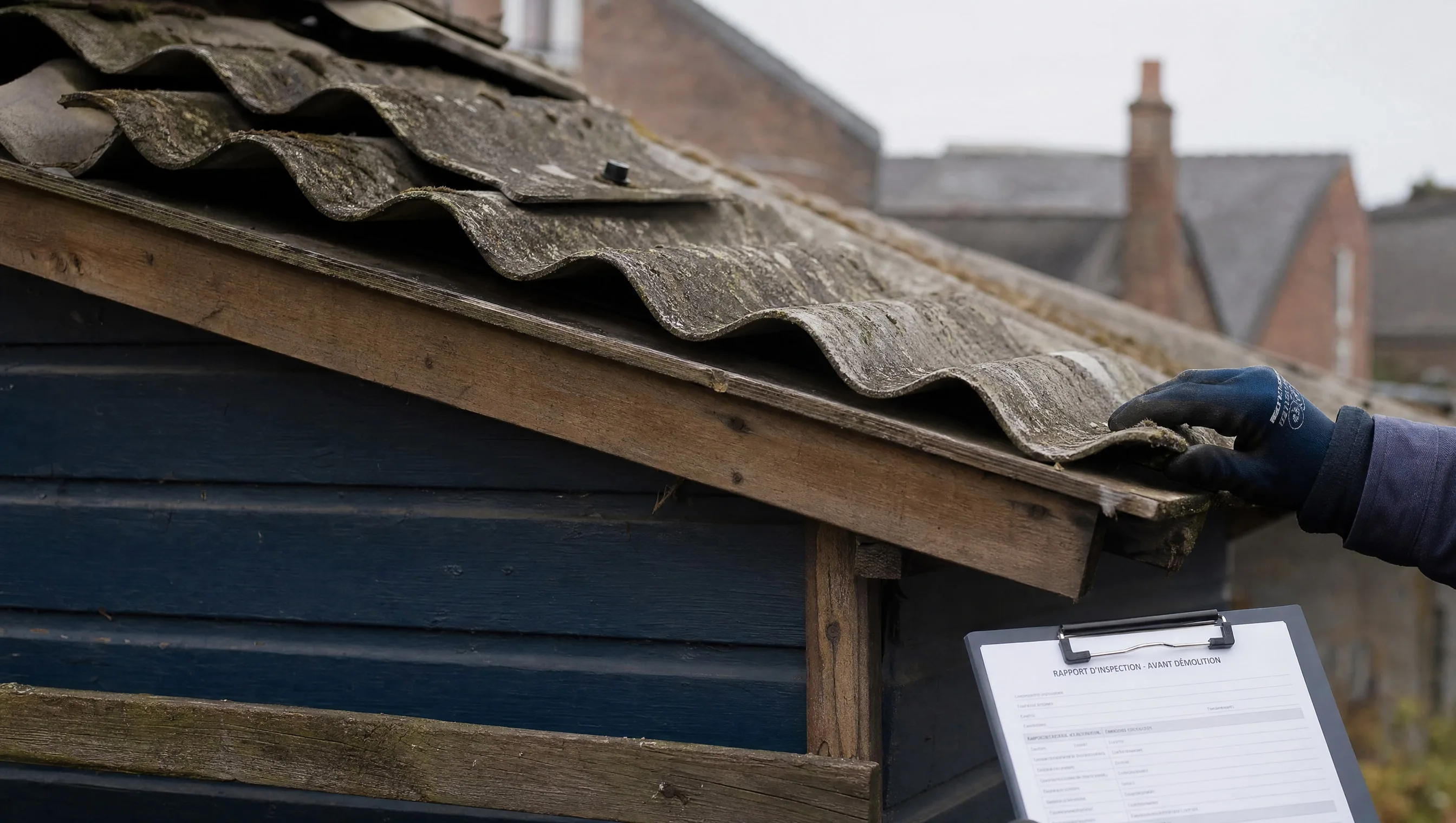
Here is where the subtlety begins. If your new build replaces a structure demolished before 2026, asbestos residues may remain in the backfill, under the slab, around the foundations or in the excavated earth. The diagnosis then does not focus on the new build, but on the historical presence of the site. This is particularly frequent in rebuilt urban areas — I saw three cases in Charleroi in 2025 where remains of fibre-cement sheets from an old shed were trapped under the new home’s earthworks, discovered two years later by owners during pool excavation.
What I systematically check on site
When the planning context requires it, I inspect three risk areas during my provisional reception missions:
- Around the foundations: residues in visible backfill, traces of white fibres in the soil
- Retained outbuildings: existing garage, garden shed, or boundary wall kept from the previous construction
- Old technical ducts: rainwater downpipes in fibre cement, masonry chimney flues, original cellar slabs
If I detect any doubt, I recommend sampling by an accredited laboratory (between €80 and €150 ex VAT) rather than visual inspection alone. No serious expert can affirm “there is no asbestos” without analysis — at best, they can affirm “I did not see any.”
What to do if the mention appears in the minutes
If the expert or contractor notes a “residual asbestos zone” or “asbestos inventory pending,” systematically demand three documents before signing:
- The certificate of disposal via an approved channel (Indaver, Renewi, Suez or equivalent)
- The hazardous waste tracking slip (BSDD)
- The final decontamination certificate of the site, if demolition took place
Without these documents, you will neither be able to resell smoothly (notaries have required them since 2024) nor invoke ten-year liability in case of late discovery. Retroactive decontamination costs run between €4,000 and €22,000 depending on the surface impacted — to be compared with the €250 it costs to verify the documentation at the time of the minutes.
Pitfalls to avoid
- Never sign minutes with a mention “asbestos to be checked” without a contractual deadline recorded
- Do not settle for an oral guarantee from the contractor — demand the Indaver slip
- Beware of certificates predating 2018, regulations have changed twice since
- If the asbestos demolition inventory is missing, suspend reception: it is an enforceable defect
For more information on the seller’s obligations in real estate, see the official portal justice.belgium.be — real estate.
What next?
Asbestos on a new build is rare but heavy when it appears. If an asbestos mention is in your file, or if your land has been subject to recent demolition, have the file validated by a third-party expert before signing. My practice regularly supports this type of verification as part of the provisional reception or a construction audit before signing the authentic deed.