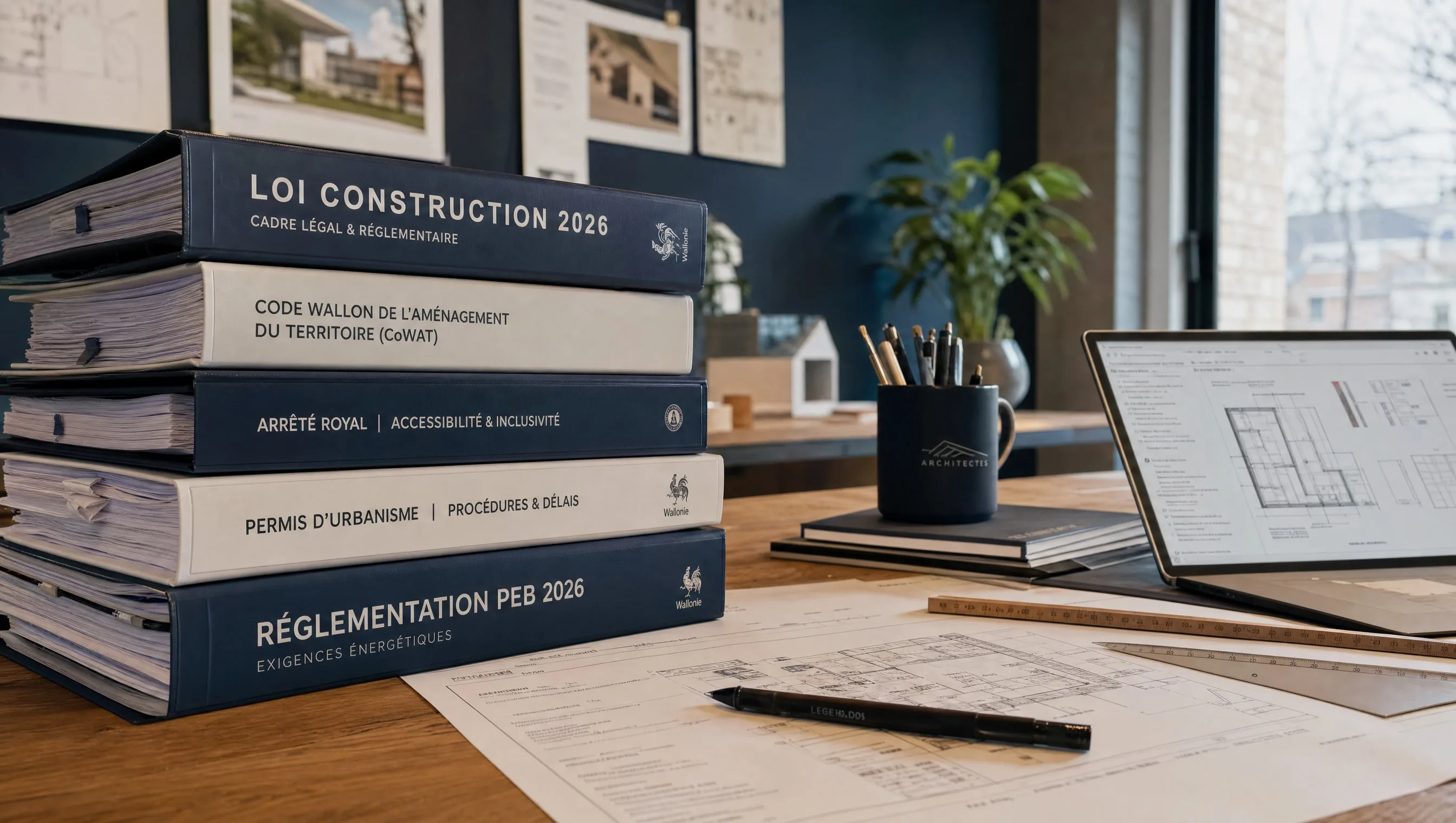
Seven regulatory developments came into force between 1 January and 1 April 2026 in the residential construction sector in Wallonia. Some are technical changes (EPC, RGIE), others are legal (extended ten-year liability), and still others directly affect site choices (mandatory EV charging). I summarise here those that really change something for a new-build owner in Wallonia, and the strategy to adopt depending on the date of your permit and the progress of your site.
1. EPC: new mandatory EPC-A threshold
Since 1 January 2026, any new residential construction must achieve EPC-A (Espec ≤ 85 kWh/m²·year instead of 170 kWh/m²·year for the former EPC-B). For permits submitted before this date, the former threshold remains applicable. Practical consequence: if your permit is from late 2025, carefully check which EPC version the contractor is applying. A mistake here can cost 6,000 to 12,000 € in insulation rework, or an equivalent value loss between classes.
See the detailed article 2026 construction regulation for the new technical thresholds.
2. RGIE: mandatory home-automation integration
Since February 2026, any new electrical installation must include a dedicated home-automation circuit: minimum 3 sockets, separate breaker, pre-wiring compatible with KNX/Modbus/Zigbee. No active home automation is required, but the pre-wiring must be present.
Verify it at the provisional reception PV — I have already seen two houses delivered without this circuit in 2026. Cost of adding it after reception: 1,200 to 2,800 € depending on configuration. Under two-year warranty if reported within 2 years.
3. Ten-year liability: liability extended to thermal insulation
The Cassation ruling of 12 March 2026 extends ten-year liability to thermal insulation defects when they render the property unfit to achieve its contractual EPC class. Before this ruling, this was considered an aesthetic or comfort defect. Now it is structural — covered for 10 years from the provisional reception PV.
This case law opens new remedies for owners of houses delivered between 2016 and 2025 if they have not achieved the promised performance. The time limit to act: 10 years from reception. See the article selling with ten-year liability for the detailed conditions.
4. EV charging: 1 reinforced socket required
Any new house with a garage must include one reinforced 32A socket (mode 2) since January 2026. Installation of a complete charging station remains optional, but the pre-equipment is mandatory: 32A supply, dedicated residual current device, cabling ready.
This obligation is part of the European 2030 plan for the transition to electric mobility. To check at the PV: presence of the socket, conformity 32A single-phase minimum, dedicated RCD at the board.
5-7. The other 2026 changes
5. Mandatory rainwater recovery above 300 m² of roof area, with a minimum 5,000 L tank for single-family houses (see rainwater tank obligation).
6. CO detectors mandatory in all rooms with a gas boiler, in addition to the smoke detectors already required. Cost: 35-55 € per detector.
7. Indoor air technical diagnosis at delivery for very airtight EPC-A buildings. Measurement of formaldehyde, total VOCs, CO₂ level. Cost: 350-550 €, at the contractor’s expense.
Which strategy depending on the date of your permit
Three typical scenarios I see in my firm:
- Permit before June 2025: former EPC-B regime applicable, just check the RGIE/EV/tank novelties
- Permit between June 2025 and December 2025: grey area, EPC-A generally applicable
- Permit after January 2026: new full regime
For sites between the two regimes, have compliance validated by an independent expert before signing the PV.
Pitfalls to avoid
- Do not rely on a provisional EPC: only the final one is binding
- Verify the delivered class vs contractual class
- Document the 3 key checks (EPC-A, home automation, EV) at the PV
- Anticipate the indoor air diagnosis in the reception timing
- Keep the ten-year liability certificate post-2026 Cassation
For the official Walloon texts, see energie.wallonie.be and ejustice.just.fgov.be — Breyne Law.
What to do next?
If your site is under way in 2026 and you have doubts about compliance with the new obligations, have your technical file validated by an independent expert. My firm offers a construction audit covering all the new 2026 thresholds, or broader Breyne Law support.