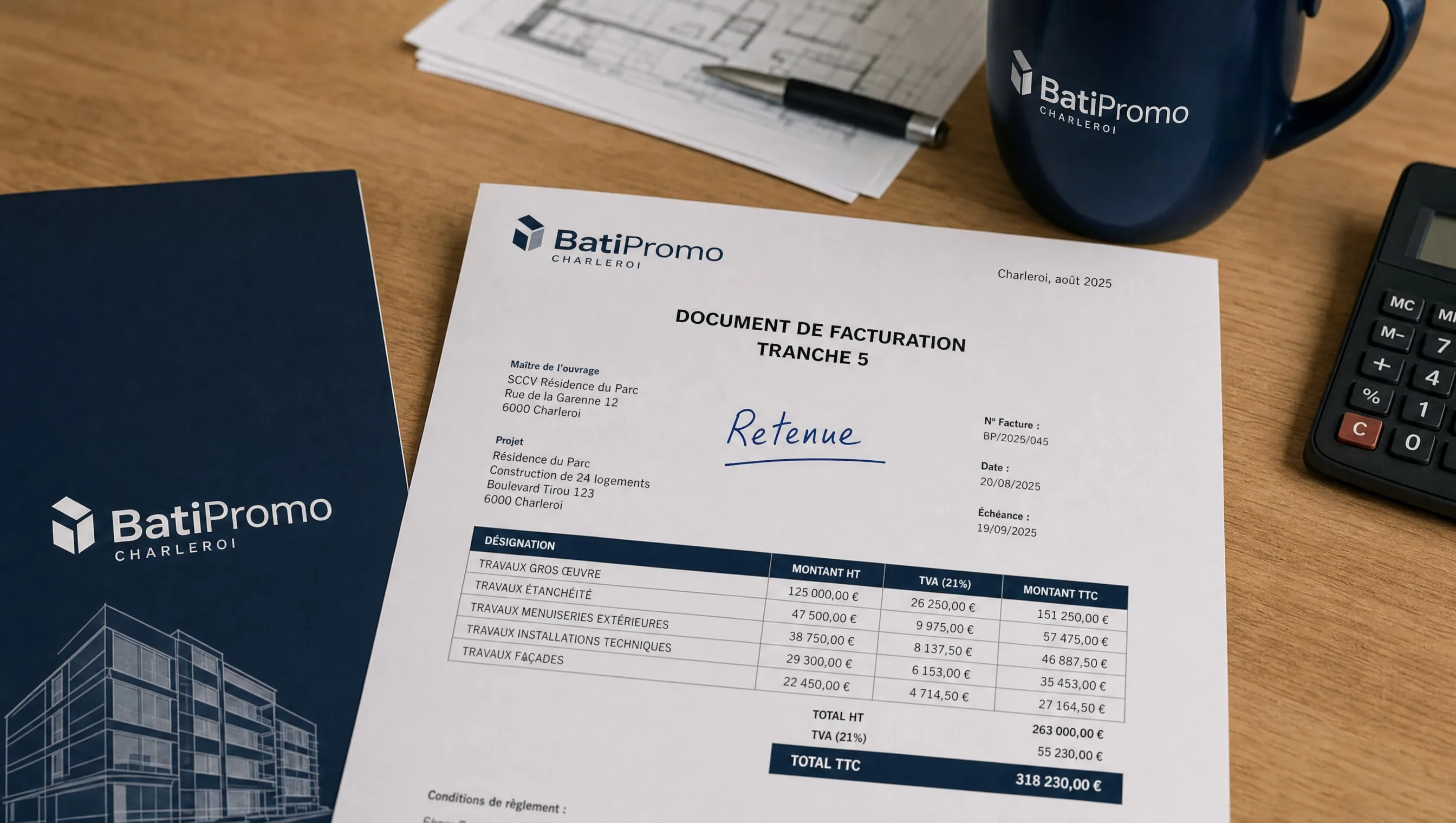
Charleroi, July 2025. Turnkey house of 178 m², six contractual instalments planned. At instalment 5 stage (fully wind- and water-tight), my client notices waterproofing defects visible on the flat roof and a poorly sealed window sill. The contractor demands payment of the instalment (€18,400). My client refuses. Refusing a construction instalment payment is legally tricky — but it is possible, and sometimes necessary to preserve your rights. Step-by-step account of this case, with the conditions, the formalism, and the pitfalls to avoid.
The context of the case
Turnkey house signed in November 2024 with a recognised builder in the Charleroi region. Six contractual instalments: signature (5%), foundation shell (15%), closed shell (25%), wind- and water-tight (20%), finishes (25%), reception (10%). At instalment 5 stage, two defects visible to the naked eye:
- Flat roof with water pools persisting 48h after rain (slope defect)
- Window sill with defective sealing, visible gap between the apron and the sill
My client calls me. I go on site within 48h, observe the defects, photograph, draft a technical inspection report. Repair estimate: €6,200. Instalment claimed: €18,400. There is clear disproportion between retained amount and repair cost, but the defect is real and well documented.
The three cumulative conditions to meet
To legally refuse the payment of an instalment under Belgian law (exception of non-performance, Article 1184 former Civil Code), three conditions must be cumulatively met:
- Objective and visible defect, ideally observed by a third-party expert. Not a mere subjective impression.
- Proportion between defect and retention: you don’t block €18,000 over a defective silicone joint. Case law applies a 1 to 3 maximum ratio (repair cost = 1, retention = 3).
- Formal written formal notice with reasonable repair deadline (30 to 60 days depending on the nature of the defect).
If any of the three conditions is missing, the judge re-qualifies as bad faith and orders you to pay default interest (increased statutory rate, 8.5% in 2026) plus possible damages for cash-flow prejudice.
The strict formalism to observe
In the Charleroi case, I recommended my client follow this procedure, word for word:
- Registered letter with acknowledgement of receipt to the contractor, with explicit mention: “refusal to pay instalment no. 5 on the basis of the exception of non-performance (Art. 1184 former CC)”
- Precise description of defects numbered and located (R1 flat roof, R2 window sill)
- Dated photos attached (8 shots)
- Deadline for compliance: 45 days
- Mention of payment “conditional on lifting of defects”
Without this formalism, the judge systematically re-qualifies as bad faith.
The unfolding of the Charleroi case
July 2025: formal refusal by registered letter. The contractor disputes and sends his own formal notice on D+15. August 2025: adversarial expertise at my request, appointment of a mutually accepted expert. September 2025: adversarial expertise report, which confirms the defects and estimates the repair at €7,800 (close to my initial estimate).
October 2025: the contractor refuses to repair, considering the defects “cosmetic”. My client brings the matter before the Hainaut court of first instance (summary then on the merits). December 2025: judgment.
Result: retention upheld
December 2025, Hainaut court of first instance judgment: retention of €18,400 upheld, court costs charged to the contractor, conviction to carry out the repair works within 60 days under a €150/day penalty. Six months of anxiety for my client, but a solid case from the start. Without a third-party expert, I am convinced he would have lost — case law is strict with poorly motivated retentions.
Pitfalls to avoid
- Never refuse an instalment without a prior third-party expert report
- Beware of minor defects that don’t justify the retention
- Don’t pay the instalment “with reservation”: legally that is a payment
- Keep photographic evidence with EXIF metadata
- Anticipate the cost of court proceedings (€6,000-12,000 at first instance)
For the legal framework of the exception of non-performance in Belgian law, see justice.belgium.be — real estate.
What next?
If you are considering refusing a payment instalment, never do so alone. My practice offers a Breyne Law advisory service with legal coordination and adversarial expertise, or a construction defects expertise to validate the materiality of the defect.