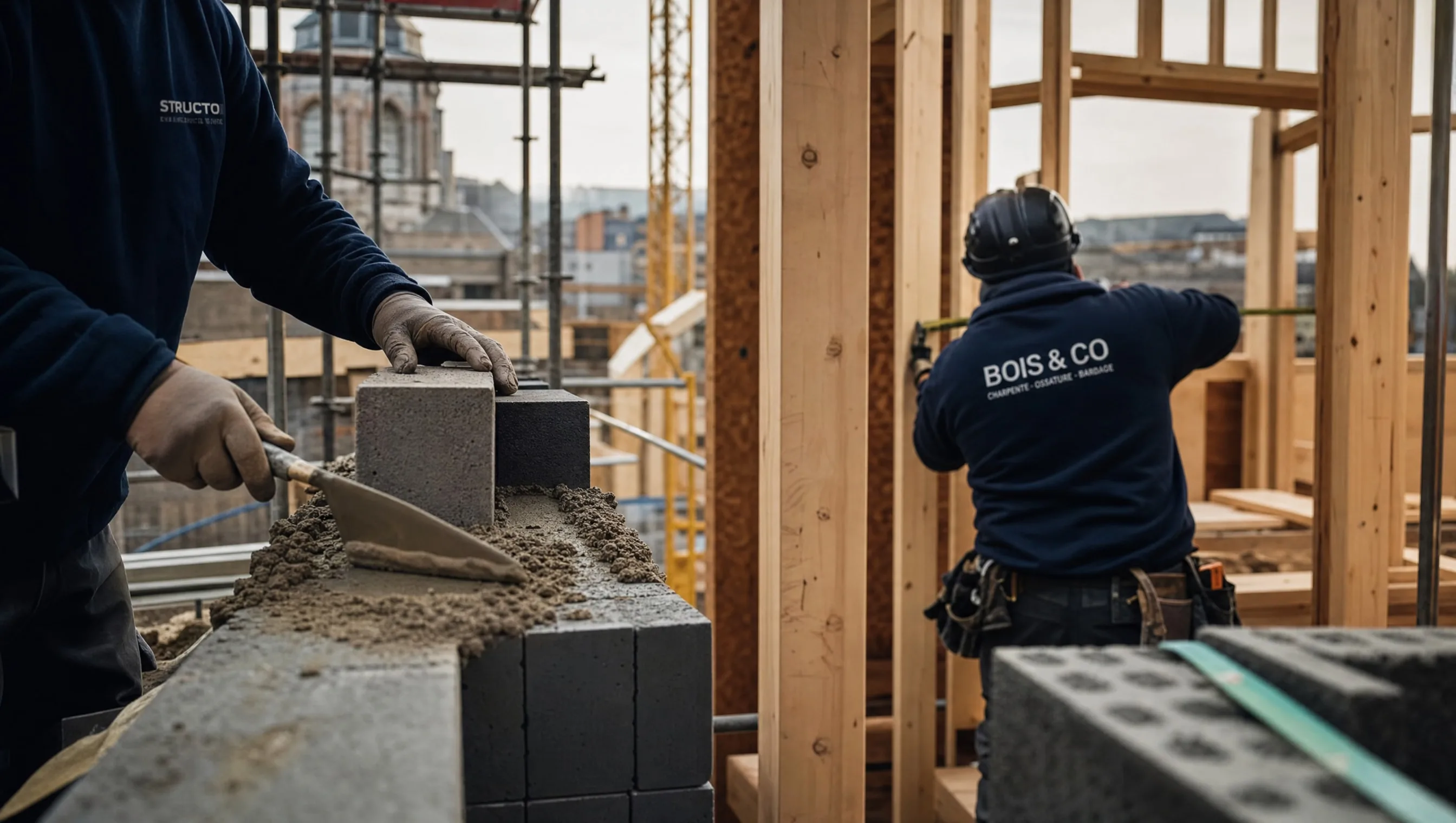
The defaulting roofer you discover three years after reception, when an infiltration appears in the roof: who was that exactly? The contract says “company X,” the subcontractor invoice says “company Y,” and Y is bankrupt. Who do you turn to? The question of subcontracting in construction is one of the most misunderstood by Belgian homeowners. On 100 turnkey projects I have assessed, 92 involve subcontractors — roofer, electrician, plumber, plasterer, tiler, gardener. When one fails, recourse is never direct, and this is often when homeowners discover the subtleties of subcontracting law.
The principle: action against the main contractor
Under Belgian law, the client has no direct contractual link with the subcontractor. You pay the main contractor, who pays his subcontractors, and he remains responsible for the entire works — including the execution defects of a subcontractor he chose without consulting you (Article 1797 of the Civil Code).
This rule protects you in two ways:
- You only have one legal counterparty to call to account
- The contractual solidarity of the main contractor covers the subcontractor’s default
- The ten-year liability runs against the main contractor, not the subcontractor
In return, you do not have the choice of subcontractor (unless your contract provides otherwise) and you cannot refuse the intervention of a subcontractor approved by the main contractor.
The exception: direct action (Article 1798 of the Civil Code)
If the main contractor owes you money and he himself owes money to his subcontractor, the subcontractor may bring a direct action against you, within the limit of what you owe the main contractor. This action is codified in Article 1798 of the Belgian Civil Code and constitutes a major exception to the principle of privity of contract.
Caution: this action only operates in favour of the subcontractor — not in your favour against him. In case of default, you cannot turn directly to the subcontractor to demand rectification. You must always go through the main contractor.
Ten-year liability: your real long-term recourse
For structural defects (shell, watertightness, stability, foundations), the ten-year liability under Articles 1792 and 2270 of the Civil Code runs for 10 years from the provisional reception. It applies against the main contractor and his architect — not the subcontractor. This is legally simpler, but it presupposes that the contractor is still solvent ten years later.
Statistically, the failure rate of a Belgian construction SME over 10 years is around 22% according to KBO data. Hence the importance of the mandatory ten-year insurance since the Act of 31 May 2017, which takes over in case of bankruptcy. Systematically check at provisional reception the validity of the ten-year certificate and the identity of the insurer — see the article selling with ten-year liability.
Pitfalls to avoid
- Failing to request the nominative list of subcontractors during the project
- Beware of contractors who change subcontractors without notifying you
- Keep the invoices justifying payments to the main contractor (protection against direct action)
- In case of default, always turn against the main contractor, never directly against the subcontractor
- Check the validity of the ten-year insurance at the time of the reception minutes
For the full legal framework of ten-year construction liability, see justice.belgium.be — real estate.
What next?
If you suspect a defect attributable to a subcontractor or you receive an unexpected direct action, have your file reviewed by an independent expert before reacting. My firm offers a defects expertise covering execution defects, or a construction audit for ongoing files.