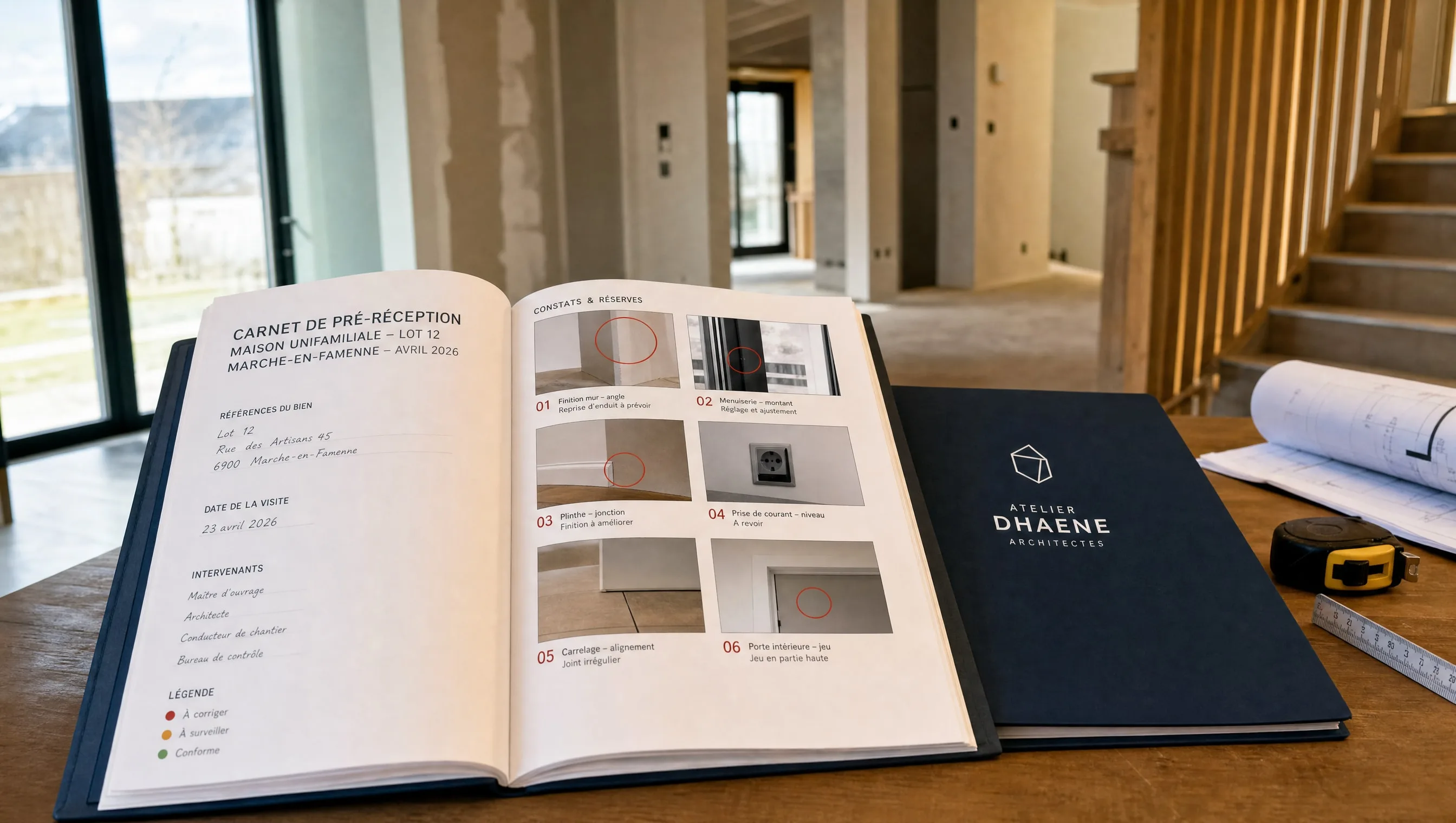
The pre-completion visit (or preliminary visit) is not mandatory, but it is the best insurance for clean minutes on the day of the official reception. Well-scheduled, it saves weeks of lifting reservations and defuses conflicts before they become legal. On 280 provisional reception files I have supported since 2021 with a pre-visit, 94% concluded with minutes containing fewer than 15 reservations, versus 31% for files without a pre-visit. The difference is massive. Here is when to schedule it and how to make it legally useful.
The right timing: 10 to 21 days before official reception
Three windows present themselves, but only one really works:
- Too early (more than 3 weeks before): finishings are not done, you list defects that will be corrected naturally, you lose credit with the contractor
- Right timing (10 to 21 days before): finishings completed, but enough time for corrections
- Too late (less than 7 days): no time to correct before the contractual date, you slip into late penalties or pressure to sign
The 10-21 days window works best on my 280 files. Beyond 21 days, some defects change (paint drying, joints shrinking). Below 10 days, the contractor has no time to coordinate fixes.
What the visit must cover
An effective pre-completion visit follows five steps:
- Full walkthrough of the house with your expert or architect (2-4 hours depending on typology)
- Listing of all apparent defects: aesthetic + functional + structural
- Dated and geolocated photographs of each defect (3-shot protocol, see reception reservation photos)
- Pre-completion letter sent to the contractor within 48 hours
- Request to lift before the official reception date
The goal is not to draft the final minutes — these will be signed on the day of reception. The goal is to give the contractor the chance to fix defects before official reception, which simplifies the minutes and accelerates the lifting of reservations.
Format of the pre-completion letter
The letter must include, for each defect:
- Number and precise location (room, wall, height)
- Technical description of the defect
- Numbered photo
- Expected action (rework, replacement, cleaning)
- Deadline for correction (before official reception)
All structured as a table to make follow-up easier.
The major legal bonus
If the contractor has not corrected a defect flagged at the pre-completion stage by the time the minutes are signed, this is legally a presumption of bad faith. The defect remains enforceable even after signing, and the judge generally grants greater latitude to the client to pursue their rights later.
Three of my files were won thanks to this archived pre-completion letter: a roof watertightness dispute in Liège (€8,200 rework), a structural crack in Mons (€14,600), an insulation defect in Tournai (€11,400). Without the prior pre-completion letter, all three would have failed.
The classic mistake: doing the pre-visit verbally
Many homeowners do an informal pre-visit with the contractor, without formal written record. It is as if it never happened. No legal value, no enforceable commitment. When the defect reappears later, it is word against word — and the contractor almost always wins in the absence of written proof.
Pitfalls to avoid
- Do not do a pre-visit too early (before finishings are done)
- Do not settle for photos without a formal letter
- Keep the postal acknowledgement of receipt
- Have an independent expert intervene rather than the architect (independence)
- Do not sign the pre-visit as “agreement without reservation”
For the legal framework of reception in Belgium, see justice.belgium.be — real estate.
What next?
If your reception is scheduled within the next 4 to 6 weeks, plan your pre-visit now. My firm offers a dedicated site pre-visit under the site pre-visit assignment, or systematically includes the pre-visit in the provisional reception expert assignment.