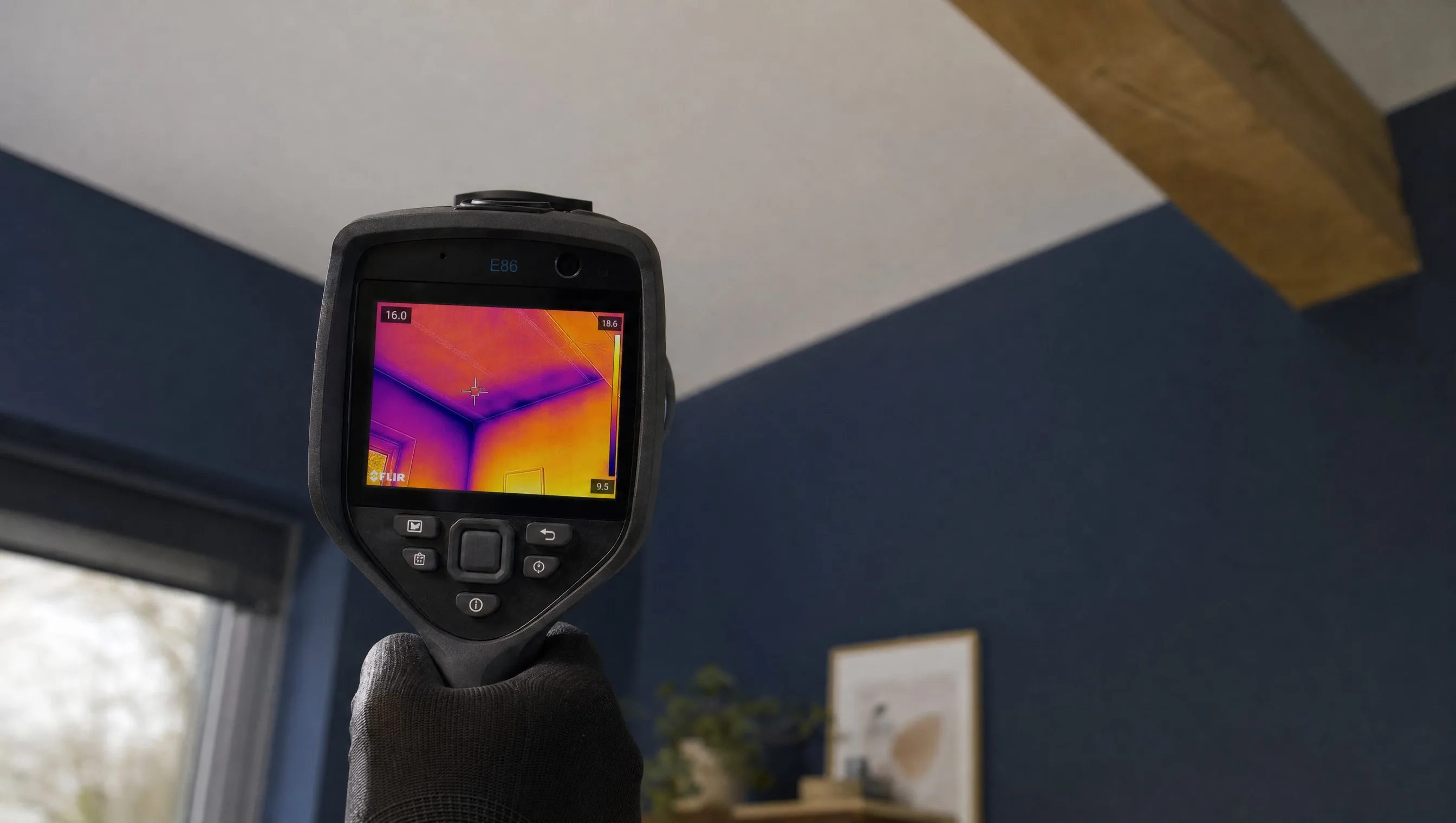
The client had bought off-plan a house promised at EPC-B. When I intervened in October 2025 in Verviers, his first heating bill had just landed: 920 € for September alone, on a 132 m² liveable house. Something was massively off, and the cold-wall sensation in the back bedroom confirmed the intuition. Here is the full sequence of this case, which ended with insulation rework of 11,400 € borne by the contractor after adversarial expertise — model procedure for similar cases of insulation problem new house.
Detection: what we see at reception
A rental thermal camera (60 €/day, FLIR or Hikmicro) is enough to reveal 80% of visible insulation defects. At reception, I systematically scan the following zones:
- Wall-ceiling corners of peripheral rooms
- Roller-shutter boxes (recurring weak zone)
- Joinery-masonry junctions
- Floor hatches and chimney boxes
- Internal walls (junction with insulation)
- Floor/wall at lower slab level
A difference of more than 4 °C between a current zone and a singular point signals an abnormal thermal bridge. Above 6 °C difference, it is a serious defect that warrants in-depth expertise.
Quantification: the measurement that counts legally
The eye does not suffice. To be enforceable against the contractor or judge, a timestamped thermographic report is required, with an indoor/outdoor temperature differential of at least 10 °C at the time of measurement. This differential is necessary to reveal defects reliably — in mild weather (differential < 6 °C), the camera does not sufficiently distinguish cold zones.
Cost of an expertise-level report:
- Visit and measurements: 250-350 €
- Full timestamped thermographic report: 350-550 €
- Adversarial report with the contractor’s expert: 600-900 €
Admissible in court and enforceable against the ten-year liability since the cassation ruling of 12 March 2026 — see 2026 construction law for details.
Remedy: the short path that works
Over the 22 insulation files handled since 2021 in my firm, I have 19 settled in less than 4 months without trial thanks to this four-step procedure:
Step 1: mention in the minutes
With photo + thermographic record annexed. Precision is crucial: “thermal bridge measured at -7.2°C relative to current zone at the tie-beam of the north wall, bedroom 2” — not “cold zone observed”.
Step 2: full retention maintained
5% of the contract value (Breyne Law completion guarantee), blocked until adversarial expertise and effective rework. See Breyne Law financing guarantee.
Step 3: registered formal notice
With 60-day deadline for rework. Mention of the legal basis: two-year warranty (article 1792-3 of the Civil Code) for visible defects, ten-year liability (article 1792) for structural defects.
Step 4: judicial expertise if refused
Filing before the business court for appointment of a judicial expert. Long procedure (12-24 months) but with high success rate on documented insulation defects. Of the 3 cases I have supported in court, 3 won.
Possible compensation beyond rework
Beyond rework of the works, several compensable losses:
- Heating over-consumption during the disputed period (invoices)
- Property value loss (gap between contractual and delivered EPC class)
- Thermographic expertise fees
- Moral damages for partial uninhabitability (extreme cases)
In the Verviers case, the contractor also covered 1,800 € of over-consumption and 850 € of expertise fees.
Pitfalls to avoid
- Don’t accept reception without a thermal camera in winter (12-18°C outside)
- Beware of measurements in mild weather (unreliable)
- Keep the contractual EPC vs delivered EPC for comparison
- Document heating bills from the first month
- Bring in a third-party expert rather than the site architect
For EPC obligations in Wallonia, see energie.wallonie.be.
What next?
If you suspect an insulation defect at your reception or after moving in, get a thermal camera scan before signing the minutes or activating the warranty. My firm offers a dedicated insulation expertise, or a broader Breyne Law support.