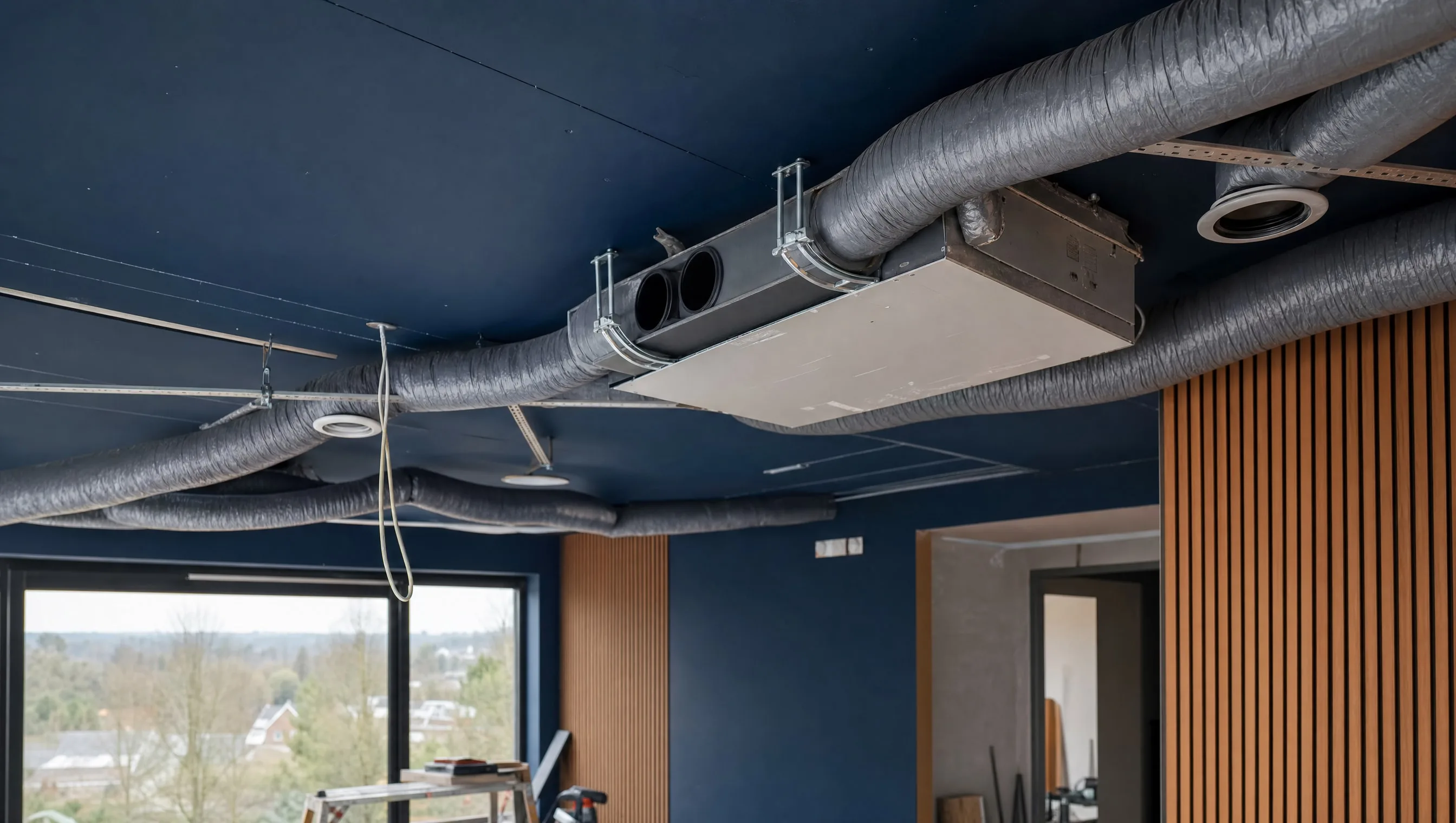
October 2024. A client calls me in panic: six months after reception, his new house “still smells of solvent”. His wife has headaches at the end of the day, their four-year-old daughter has been coughing for three weeks. I visited the next morning, windows closed since the previous evening. The smell in a new house was there, discreet but persistent, behind the living-room sofa. Here is what three similar files taught me, and how to distinguish a normal smell from one that warrants an air measurement.
What is normal for six to twelve months
A new house naturally “off-gasses”. Paints, varnishes, parquet adhesives, MDF, insulation foams, sealing mortars, silicone sealants: all these materials release volatile organic compounds (VOCs) for months after installation. It’s mechanical, predictable, and harmless to most occupants.
The typical, faintly perceptible “new” smell that gradually fades and disappears after thirty minutes of ventilation is the normal course of things. It generally subsides between 6 and 12 months after moving in, faster if mechanical ventilation (single or dual flow) works correctly. The full drying time of a new house is estimated at 12-18 months on average — see the dedicated article new house drying time.
A few causes of normal smells:
- Fresh glycerol or acrylic paints (2-6 weeks)
- Laminate or solid parquet adhesives (3-9 months)
- Varnish on interior joinery (1-4 months)
- Sanitary silicone joints (2-3 weeks)
- New plastics (sheaths, taps, appliances): 4-8 weeks
What should alarm you
Four signals fall outside the norm and warrant immediate vigilance:
- Persistent smell more than 12 months after moving in, without reduction
- Mouldy smell (trapped moisture, hidden leak)
- Rotten-egg smell: gas leak, absolute emergency, call the Belgian gas hotline 0800 87 087
- Recurring sewer smell (badly fitted trap, blocked roof vent, defective connection)
If anyone in the house develops headaches, eye irritation, chronic cough or nausea, do not wait. These symptoms, especially in children and the elderly, are a serious indicator. The concentration of formaldehyde, total VOCs or benzene can exceed WHO thresholds in 4 to 8% of new houses according to studies — the risk is not marginal.
Investigation method
When called on a “persistent smell” file, I always follow the same four-step protocol:
- Visual inspection: search for damp zones, leaks, black traces
- Ventilation test: check single or dual-flow MVHR, airflow rates, filters
- Traps and vents inspection: under sink, bathroom, terrace, outlet inspection chamber
- Air measurement: if nothing obvious, sampling and lab analysis
This protocol identifies the origin in 85% of cases. For the remaining 15%, additional expertise from a building hygienist or environmental physician becomes necessary — both professions have existed in Belgium since 2018.
My Namur file
The smell came from a laminate parquet adhesive laid in May on an insufficiently dry screed (residual humidity at 4.2%, where the standard requires less than 2.5%). The vinyl adhesive slowly fermented over six months, releasing aldehydes beyond thresholds. The installer had to redo everything — complete dismantling of the parquet, floor reworking, relaying after drying: 9,800 € at his expense, after adversarial expertise and invocation of the two-year warranty (article 1792-3 of the Civil Code).
The family could stay in the house during the three weeks of work, the smell having disappeared 48 hours after the parquet was lifted.
Pitfalls to avoid
- Do not confuse “new smell” and toxic smell: the second causes symptoms
- Do not mask with home fragrances — you also mask the alert
- Do not wait 18 months before having air measured: the two-year warranty only covers 2 years
- Keep material invoices: indispensable to invoke product liability
For official health thresholds in Belgium, see the FPS Public Health — environment website.
What next?
If you have any doubt about a persistent smell or unexplained symptoms since moving in, don’t delay. My firm offers a construction defects expertise that includes smell diagnosis and coordination with an air analysis lab. For urgent cases, request a free quote specifying the symptoms and how long they’ve been present.