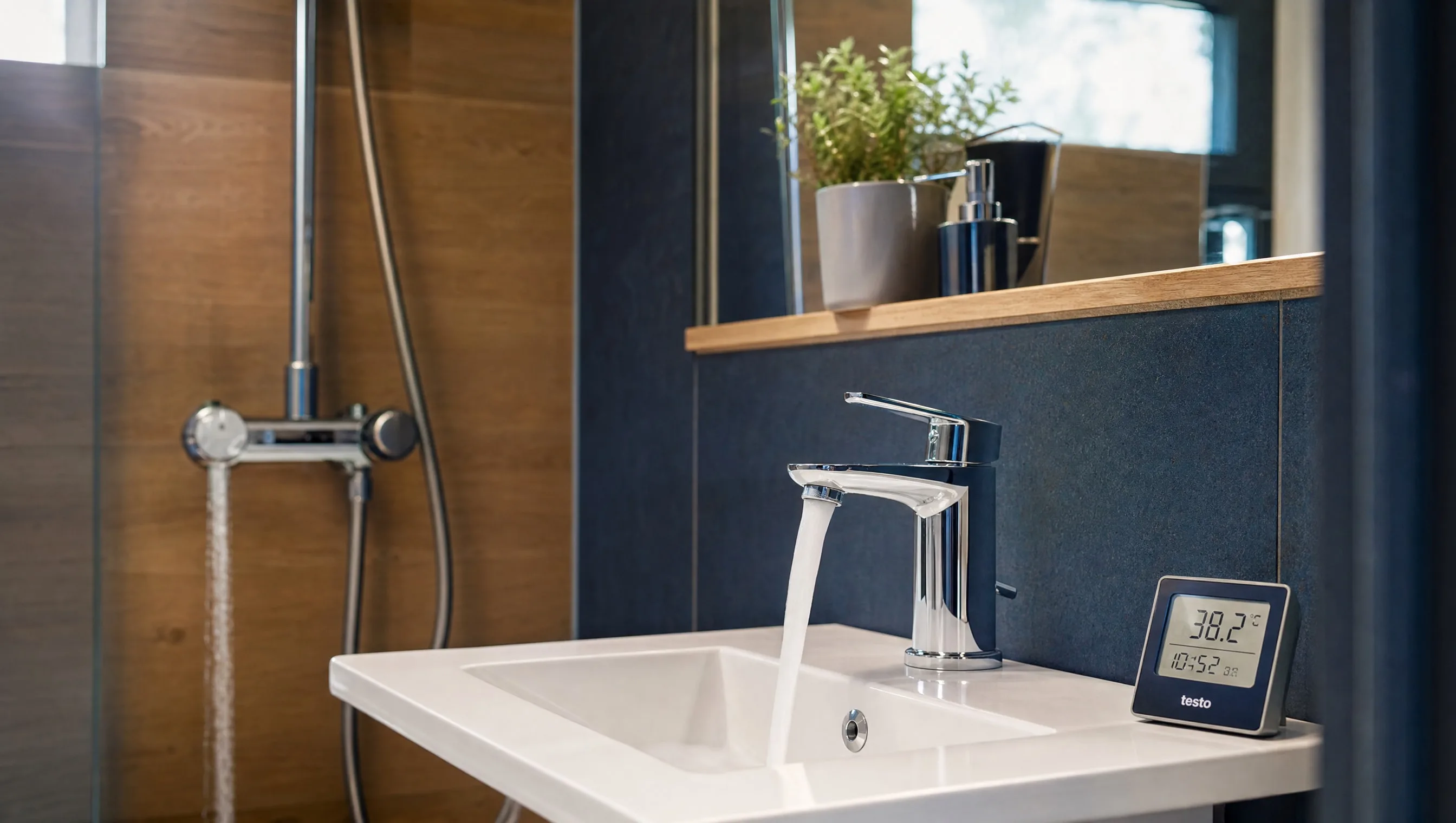
Across 412 receptions where I inspected the plumbing line by line, I recorded on average 2.3 plumbing defects per house. Three quarters would have been detectable on the visit if the expert had taken time to open the water everywhere, at real pressure and temperature. Plumbing does not forgive inattention: a poorly tightened fitting, a missing trap, an insufficient drainage slope, and it’s 4,000 € of repair after the fact, with frequent collateral damage (plaster, parquet, paint). Here is my complete 18-point routine for the provisional reception, to be run through systematically.
Hot water production and distribution (6 points)
-
Hot water outlet temperature: 55 to 60 °C max, measured with a digital thermometer. Above, burn risk; below, legionella risk if stored.
-
Hot water arrival time at the furthest point: above 25 seconds, the loop sizing needs to be revisited. A properly sized loop delivers in 8-12 seconds.
-
Network pressure: 3 to 4.5 bar ideally, checked with a manometer connected to a drain valve. Above 5 bar, risk of water hammer and premature leaks.
-
Pressure reducer: presence and operation if inlet pressure > 4 bar. Check the setpoint value and proper tightening.
-
Thermostatic mixer tested at 60 °C then at 20 °C to detect cartridge leaks. Test at least two bathrooms if the house has several.
-
Main meter accessible, sealed, reading taken in the minutes with photo. Without this photo, impossible to prove the initial consumption in case of billing dispute.
Drainage and watertightness (7 points)
-
Drainage slope: 1 % minimum for wastewater, 2 % ideally. Check with a 60 cm spirit level on visible portions.
-
Traps present on every sanitary appliance, including washing machine and dishwasher. Frequent oversight causing odour back-flow.
-
Primary roof ventilation (stack), otherwise toilets gurgle on every flush and sinks empty in jerks.
-
Watertightness of silicone joints around baths, showers, washbasins. Run your fingernail across: if it catches, it is poorly smoothed. Request repair before signing.
-
Properly sealed drains on washbasins, sinks, showers. Test by filling the washbasin, opening the drain and checking for the absence of leak under the sink.
-
Walk-in shower drain channels with slope checked with a rule. Poorly laid walk-in shower is the leading cause of upper-floor infiltration I handle.
-
Flow test: open all taps for 5 minutes continuously, and run your hand under every trap. Four leaks out of five appear in this interval.
Tapware, finishes and documents (5 points)
-
Mixers without leak when cartridge is removed, checked with hand placed at the base of the gooseneck. Test every mixer in the house.
-
Shut-off valves accessible under every sink and washbasin. Indispensable to intervene in case of leak without cutting the whole house.
-
Silent flush and adjusted flow rate (between 6 and 9 L per standard flush). Check the dual eco command on all WCs.
-
Rainwater recovery properly connected (tank mandatory in 2026 in rural zones, see 2026 construction regulation). Check the pump, filter and connection to the WCs or garden tap.
-
CERGA gas inspection valid if gas boiler. The certificate must be dated less than 6 months and signed by an accredited body.
Useful tools to bring
For a complete plumbing reception, I systematically bring:
- A digital thermometer (10-15 €)
- A manometer with quick connector (35-50 €)
- A spirit level of 60 cm (20 €)
- A headlamp (12 €)
- A notebook with a pre-printed list
Total equipment around 80 €, to be amortised over a lifetime. It is also an excellent investment for owners who want to check the plumbing of their previous house before buying.
Pitfalls to avoid
- Don’t forget to test hot water at the furthest tap (kitchen or attic bathroom)
- Beware of brand-new mixers never turned on: may hide a defective cartridge
- Check the terrace-roof drainage slope (forgotten in 12 % of cases)
- Keep the original CERGA gas certificate with your owner file
For official plumbing standards in Belgium, see aquawal.be — drinking water in Wallonia.
What’s next?
If your reception involves a complex plumbing scope (several bathrooms, underfloor heating, rainwater recovery), entrust the inspection to a third-party expert. My practice offers a dedicated plumbing expertise, or a broader provisional reception expert covering all trades.