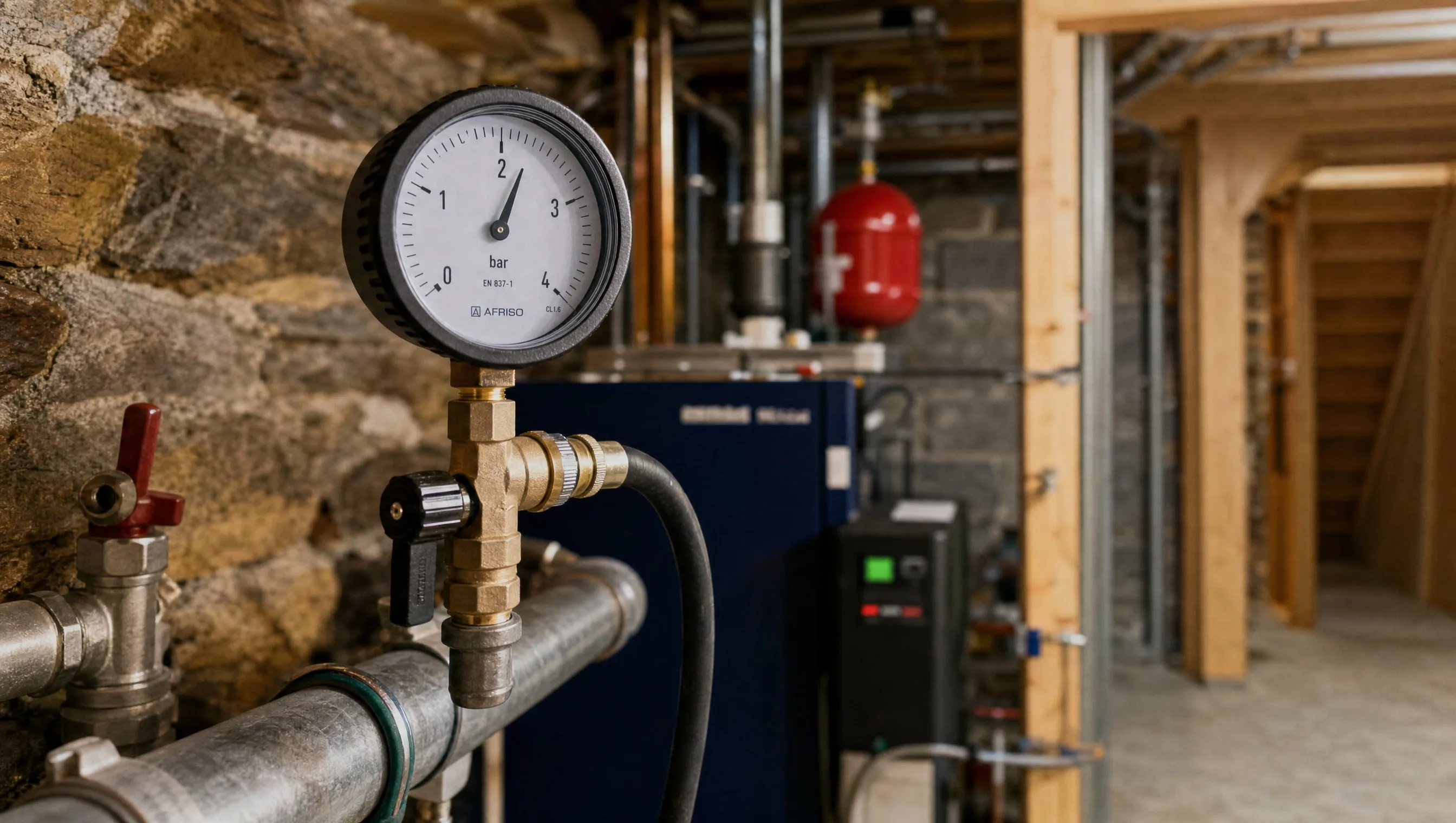
At every provisional reception, two tests take 90 minutes but save 80% of equipment defects: pressurising the water network and full heating-up. A boiler that bangs at startup, a mixer that leaks at 60°C but not at 20°C, a noisy ventilation system in boost: all these defects only show under real load. Here is my detailed protocol, refined on 280 projects where I have run these tests systematically.
Water network pressure test
The standard method on the projects I assess:
- Close all taps and bleed air from the full circuit (radiators, mixers)
- Pressurise to 1.5 times the nominal service pressure (in practice, 6 bar for a residential network at 4 bar)
- Hold for at least 30 minutes and read the pressure gauge every 5 minutes
- Acceptable tolerance: drop ≤ 0.3 bar over 30 minutes
- Beyond 0.3 bar drop, there is a leak — often invisible to the eye, sometimes critical
On 280 tests in the office, 22 revealed a micro-leak at a poorly tightened press fitting, generally at the following points:
- Water heater fitting on the copper pipe (8 cases out of 22)
- Mixer fitting in invisible basement (6 cases)
- Isolation valve at the main meter (4 cases)
- WC tee fitting (4 cases)
The test takes 45 minutes in total and costs €0 in tooling if you own a pressure gauge — €35 investment at Brico, amortised across all your projects.
Full heating-up
When I arrive on site, I systematically ask for the whole heating installation to be put on maximum demand:
- Thermostats at 24°C in every room
- Domestic hot water at 60°C
- Boiler on and in demand
While I walk through the house (minimum 90 minutes), the installation loads up. At the end of the visit, I check four parameters:
- Hot-water outlet temperature at the furthest tap: must reach 55°C minimum within 25 seconds
- Burner startup noise: abnormal banging = ignition or circulation problem
- Radiator surface temperature: uniform or a cold spot at the bottom = poor bleeding or sludge
- Circuit pressure: 1.2 to 1.8 bar when hot (and stable over time)
Double-flow or single-flow ventilation test
Also test the ventilation:
- Boost mode for at least 15 minutes
- Actual extraction via flowmeter: ≥ 30 m³/h in kitchen, ≥ 15 m³/h in bathroom
- Flow direction of the vents: supply in bedrooms, extraction in service areas
- Sound level in night-silence mode (< 30 dB in bedroom)
- Filters clean, accessible, dated
A wrongly set ventilation system at commissioning is a frequent defect — see the article new house condensation for the consequences (condensation, mould, air quality).
Technical documents to request
Beyond the physical tests, systematically ask for:
- CERGA certificate if gas boiler (mandatory)
- Boiler technical sheet with manufacturer warranty
- Pre-filled annual maintenance log
- Ventilation user manual in French
- Pipework as-built diagram
Without these documents, future maintenance and warranty interventions will be compromised.
Pitfalls to avoid
- Do not test the boiler without 30 min of prior heating
- Beware of “pre-set” installations without on-site adjustment
- Check the dynamic pressure at peak demand
- Systematically test the thermostatic mixer at 60°C then 20°C
- Keep the contractor’s commissioning report
For the regulatory framework of heating installations, see energie.wallonie.be.
What next?
If your reception involves a complex heating installation (heat pump, underfloor heating, solar thermal panels), entrust the check to an independent expert. My firm offers a dedicated heating expertise, or a broader plumbing expertise.