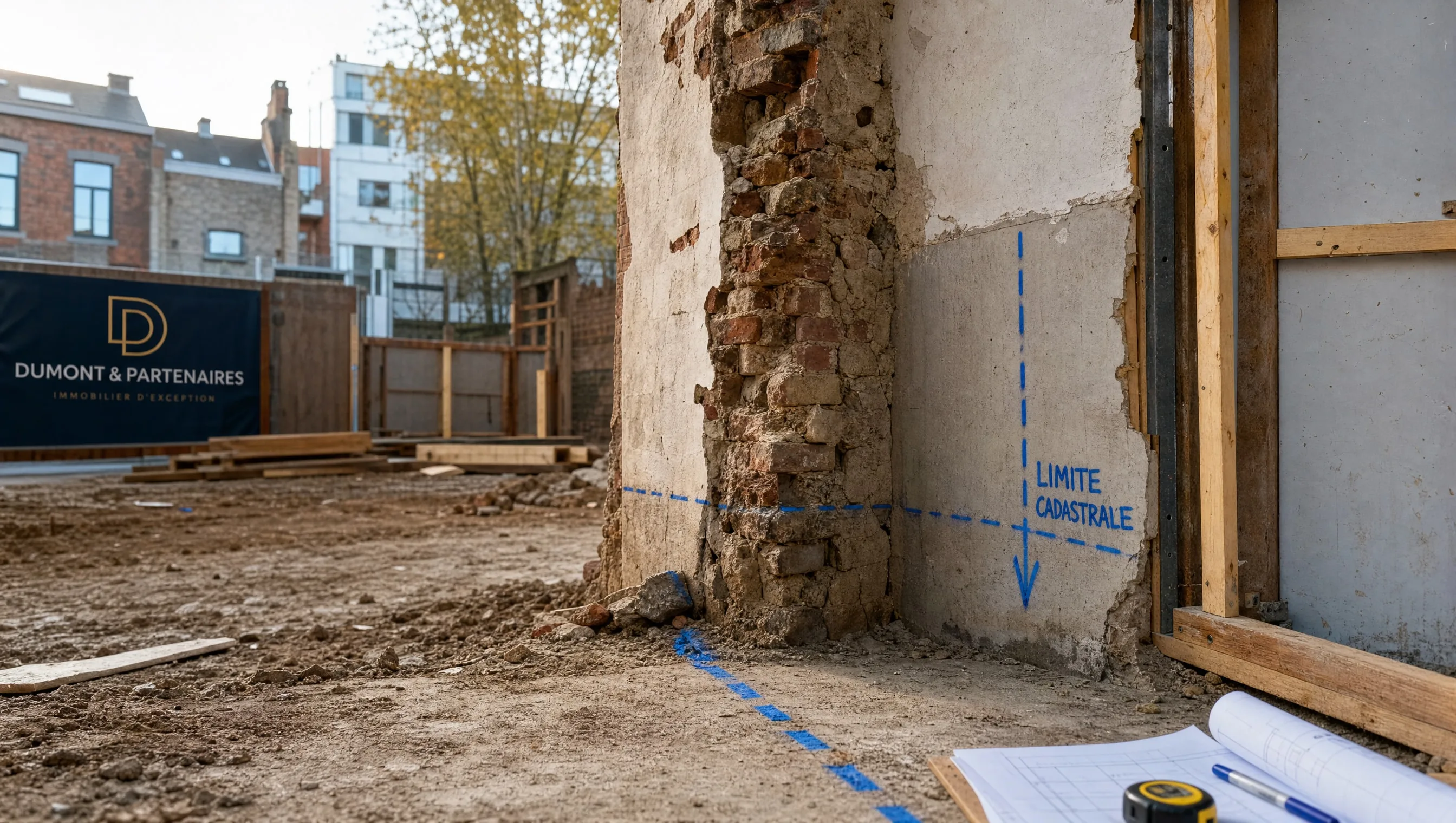
Building on a party wall is not a neutral act. The neighbour has rights that apply even when your permit is in order, and three out of ten urban Walloon construction projects generate a neighbour dispute according to 2025 municipal data. Of the 80 projects I have supported since 2021, about 24 have involved a neighbour dispute — often avoidable with a little legal preparation upstream. Here is the framework of Belgian law, the easements to respect, and the good practices to apply from project start.
The prior schedule of condition: step 1
This is the first step, and the most neglected. Before any demolition, earthworks or construction at the boundary, an adversarial schedule of condition of the neighbour’s property must be drawn up by a bailiff or expert. Cost: €350 to €700 incl. VAT depending on the size of the neighbour’s property and complexity.
Without this prior record, any crack discovered at the neighbour’s during the works will be attributed to you by default, and the burden of proof to the contrary will fall on you. This reversal of the burden of proof is a major pitfall under Belgian neighbour-nuisance law.
The prior schedule of condition must cover:
- External façades of the neighbour’s property (high-resolution photos, dated)
- Interior party walls if access is granted
- Existing cracks measured and located
- Levels and plumb of load-bearing walls
- Floors and tiles in adjoining rooms
- Roofs and chimneys if visible
Belgian Civil Code easements to know
The new Belgian Civil Code (Book 3 on property, 2020) takes over and clarifies the historical easements:
- View easement: no straight opening within 1.90 m of the boundary, no oblique opening within 0.60 m (Articles 678-679 old CC, taken up in the new 2020 CC)
- Plantation distance: 2 m from the boundary for trees over 2 m high, otherwise 0.5 m
- Party-wall right: the neighbour can require co-ownership of a wall built on the boundary, against reimbursement of half the cost
- Drainage easement: no modification of the natural rainwater flow direction
- Daylight easement: high openings (minimum 60 cm above interior floor) permitted
Abnormal neighbour nuisance
During the works, several nuisances may constitute an abnormal neighbour nuisance, actionable even without proven fault:
- Excessive noise (above 75 dB at the parcel boundary during the day)
- Persistent dust on neighbouring properties
- Vibrations (pile driving, heavy demolition)
- Material storage overflowing onto the neighbour’s plot
- Vehicle access through the neighbour’s property without authorisation
Reasonable limits:
- No works before 7am or after 7pm on weekdays
- None on Sundays or public holidays
- Covering of stockpiles within reason
- Written information to neighbours before start of works
A notice letter to neighbours before start and respecting these hours prevent 80% of the conflicts I subsequently handle.
Pitfalls to avoid
- Do not start without a schedule of condition at the neighbour’s
- Check the easement measurements on plan before any opening
- Beware of “verbal agreements” with neighbours
- Keep dated photos of every visible modification
- Have a written authorisation signed if access through neighbour’s plot
For the legal framework of neighbour nuisances in Belgium, see justice.belgium.be — real estate.
What next?
If your project is ongoing in an urban area or you are in a neighbour dispute, have your file reviewed by an independent expert. My firm offers a crack expertise for adversarial records of defects appearing at the neighbour’s, or a broader construction audit.